Showing posts with label riches. Show all posts

Acres Of Recycling Plastic And Aluminum, Acres Of Diamonds


Riches are found sometimes in the most unlikeliest of places, and wealth creation is sometimes dressed up in work boots disguised as lowly "meaningless stuff". Nevertheless, there is always gold and riches if you look for them anywhere regardless of where it may hide.

What do you think of when you think of riches? I feel that is an appropriate question to start this article off with, because, stereotypical riches are "easy" to come by like lottery winnings or a legal stock market win in a good market. But the real riches are something you have to look for. What I mean is for example: when Bill Gates, Steve Jobs, Steve Wozniak or Mark Zuckerberg got into computers they were not considered serious networking tools, or communication devices, they were toys. Remember Nolan Bushnell and the Atari gaming systems, Bally Games or Sega Games or the Pac-Man video games years ago. What happened to this perception of computers, those guys like Bill Gates, Steve Jobs, Steve Wozniak, and Mark Zuckerberg looked for the wealth potential in the toys and "trivial things" and made them into riches instead of waiting for the idea to come to them. I say all this not out of envy or "look at them", but I say in understanding: Riches come in the form of insignificance, "toys" or silly seeming nothing in their rough form. Look at the old Russell Herman Conwell essay "Acres of Diamonds", the farmer Ali Hafez thought that his diamonds were just rocks in the creek bed, and look what he was really sitting on if he looked a little more into it. On the other hand, the eighteenth century railroad magnate James Jerome Hill built a fortune on this principle in the cold, "valueless" Northwest region of North America near Canada if you look deep into the old encyclopedias and history books. So, think about that fact for a moment, before you make fun of the "stupid guy" or "silly gal" looking for that wealth in the impossible, think for a moment what they really could be doing, and get a niche or unique value yourself!

Indeed, I will make this statement and it will sound silly until you really think about it: All real opportunity is really recycling, right down to Alexander Graham Bell turning the screw and making speech possible on the phone where the other inventors could only sing on the phone like a toy microphone at best. I am not only saying be alert, but be deeply realistic in an abstract way that works to make you rich ultimately. "The town weird person" at first, great and prosperous later. It is all application and understanding that makes it anyway, regardless of the realities "normally perceived". If you want greater than normal results, you have to be abnormally creative. If you listen and perceive hard enough, your answer could be blowing in the wind, and look! "X" marks the spot where you least expect it.


https://ezinearticles.com/?Acres-Of-Recycling-Plastic-And-Aluminum,-Acres-Of-Diamonds&id=10018619

Is Anyone Disadvantaged From Getting Rich?


From my own experience of interacting with poor people, the complaint and excuse is always lack of opportunity or luck. Many poor people believe that riches and wealth is only a matter of luck, and those who are rich are only lucky to be so. Let me correct this idea that opportunity to be wealthy or rich is limited, no, the opportunity to be rich in this world is unlimited and open to all who are willing to exploit them. The opportunities are so limitless that anyone, male or female, black or white, from any race or ethnic origin can rise from the poorest of the poor to become one of the richest men on the face of the earth.

A look at the universe will show you the riches of God's creation, the vastness of the earth will confirm to you that there are too many opportunities yet untapped. The universe contains about one billion galaxies of stars. Each galaxy contains more than one billion stars, the sun to which the earth revolves belongs to the galaxy of stars called the Milky Way. This Milky Way galaxy is said to contain about one hundred billion stars, and the sun of our solar system is just one of the stars. There are mega stars, far bigger than the sun. This star we call the sun is having a solar system of which nine planets including the earth revolve, the earth is so tiny in size compared to the bigness of the sun. The sun is said to be more than a million times bigger than the earth. All these are in the universe created by God. Why did God create all these? To show man the vastness of resources and opportunities.

The earth which is so small compared to the sun is so big that it contains mountains and oceans and seas, and vast land with rich contents. The plants, animals and fish on earth continues to increase and multiply. Everything is on the increase, as man's population is increasing so are animals, fish, and plants. Knowledge to exploit and venture into production of agriculture and all other sectors of human needs are daily increasing and everyday, man is doing great things on the earth. The opportunities are increasing for everyone who can tap into it to become rich. Please note this, the opportunities are not decreasing but increasing everyday, and the floor is opening up for anyone who thinks he can. I know you can, that is why you are reading this. If one area of business is saturated, there are so many other areas that is waiting for people to step in and become as rich as they can ever imagine. No man is ever disadvantaged due to lack of opportunities or luck. Wealth is not a product of luck but a product of discovery.

Anyone who is bold to see these opportunities and tap into them will be rewarded with wealth. The good news is this, there is no limit to how much money you can make, whether you are young or old, male or female, weak or strong, handsome or ugly, bodily disabled or anyhow, you can amass wealth more than you can ever imagine. If you will believe and accept this theory then go ahead to discover your wealth through exploiting the opportunities open to you


http://ezinearticles.com/?Is-Anyone-Disadvantaged-From-Getting-Rich?&id=9502318

Secrets of Prosperity


The Secret of Prosperity is really very simple. The Creative Principle that brings about abundance, health, riches and great relationships is the very same one you are now using to command lack, sickness, sorrow and lack into your life space!

The heart of this great secret can be found by answering one simple question. What do you identify with? Don't respond with a glib answer, sit with the question for a while, perhaps even a few days. If you need a bit more help look at your life. What are your present circumstances? Write them down. For best results take a few days to do this exercise.

What you are experiencing at this time is the result of you using Creation Principles to bring into form exactly what you are asking for through what you identify with. An identity of I Am sick brings about sickness. When you identify with I Am broke you are bringing about poverty. Whichever state you say you are always reflects perfectly with life experiences. It's law.

In order to change any state of experience you must change your State of Being. Prosperity is assured when you totally identify with Being Prosperity. It's a head game to be honest. You have got to change what's going on in your head as it affects what you are feeling and what you are feeling brings about more of the same.

Try this exercise for a week or longer.

Start by honestly identifying what state you are presently in. Write it down. Now write down thoughts that you consistently have that lead to the feeling of being in that state. Take your time with this first part as it will help you to move into a new state of being.

After finishing the first part of the exercise ask yourself if those ideas, beliefs, are working to your benefit? Are they getting you the results you want? No? OK, time to move on to the next step of the exercise.

What thoughts, beliefs, would you need to hold as true in order to live as you desire? What beliefs lend themselves to success, abundance and prosperity? Write these down. As you read through them notice your reaction to them. Where do you feel uncomfortable? This is an indication of a belief lodged there that you need to release in order to replace it with a new program that works as you would like to experience yourself.

Next you want to practice this new State of Being I Am Prosperous. At first it might not feel true or real for you, but through practicing the abundance that is all around you, in just a little while you will start to see the result. Be aware and alert to notice as proof of prosperity shows up. Pick up the change that is there for you in the parking lot. Celebrate it. The more you stay in the Feeling Place of I Am Prosperous, the more it will show up.

The Big Secret to Prosperity is Being in that State of Being and that comes about through practice.


http://ezinearticles.com/?Secrets-of-Prosperity&id=9490808

5 Simple Steps To Success

Virtual Reality, Consciousness, Reality, Mind

Do you think that all wealthy people are successful?

Success is more than just making money. Money makes life comfortable, no doubt. Money also gives you the opportunity to contribute to worthy causes (it's hard to help the poor if you are one of them)! But that's not all there is to being successful.

Success is when we reach for the highest that is within us and give the very best that we have. It is in the doing and not the getting.

Success is not in the accumulation of riches and resources and doesn't bring happiness. It is in the steps you take, and the attempts you make along the way.

Step 1: Accept Life As It Is

Life is a journey - accept this even with all the challenges that come your way. Save yourself a lot of energy by embracing this first step.

Step 2: Adapt To Life

Successful people don't complain and whine, but keep a positive attitude towards life. Ever notice how draining it is when you are around someone who constantly complains?

Everyone can have a 'woe is me' story at some point in their life, but it's the way you adapt to life that will make a big difference for you.

Step 3: Accept Responsibility For What Is Happening In Your Life

Take full responsibility for your life choices. Always look for the good in your life and in others.

Say YES to life! Don't close yourself off from opportunity. Embrace and explore them!

Step 4: Expect Positive

Do you know someone who always looks for the negative? If that is what you look for, that is what you will get. You will find what you are looking for, so look for the positive.

Focus on positive relationships in both your personal and professional life. Make it a habit of bringing out the best in others so they can be the best they can be.

Step 5: Have A Direction And Purpose In Your Life

Successful people know where they are going. They set goals, accomplish them and then set more goals. They are never bored, but always looking for new experiences. See the world as a sea of opportunity!

There is no line between success in your personal and professional life. Success is the one standard for your whole life. As you understand the difference between existing and living you will enjoy life to the fullest.

Always choose living and you will have success.

http://ezinearticles.com/?5-Simple-Steps-To-Success&id=9347610

Money and Wealth Flow to Me Easily


Money and wealth are like a cat. They have no interest in being around you, when you demand that they come, however when you're having fun, and doing your best to enjoy life, they just pop up, and cosy up right next to you. This was when I realized that limiting beliefs are what holds us back from achieving riches and wealth.

People in this day and age spend a lot of their time in misery. They have debt piling up and work in jobs that bring them no joy. Their prevailing thought processes dictate to them that they have to live life this way and that is absolutely false. Once you realize what these limiting beliefs are, you are able to deal with them in a healthy way and remove the blocks, that keep you from bringing wealth and happiness into your life.

Wealthy people have replaced limiting thoughts such as "I don't have enough", and "I can't afford that", with empowering thoughts about money such as "I have plenty", and "It is easy for me to make money". With the proper mindset locked in, they then take positive steps towards making money. They know that making money, and bringing in wealth, are centered around providing quality work in a field that you enjoy doing. We are all here for a purpose, and aligning ourselves with that purpose allows positive vibrations to flow through us, and with this positive energy the money starts flowing.

When people act and think in terms of abundance, they find that abundant people are attracted to them. This is the law of attraction in a nutshell, and it brings about even more abundance into our lives. Wealthy people love to be around wealthy people, because they are always thinking of ways to help other people. They learned early on that they cannot make it alone, and put effort into helping each other, and giving back to the community.

They remember that they have so much, that they can give plenty away, and still have more than enough for themselves. The irony of this situation is that the more they give, the more that comes back to them. Making wealth flow effortlessly towards you may seem simple in definition, however putting these actions into practice is the real challenge. Anybody who wants to develop themselves into wealth magnets badly enough, can make it happen. We are all limitless possibilities just waiting to be explored.

What do you do if you have a new business idea? Most people will go through a research phase, to find out if their idea is viable, if there is a demand for their product or service. Unfortunately, this is where budding entrepreneurs tend to get stuck, in this research phase. After all, there's always a new research to be done, there's always a new things that crop up, that need to be followed up on. If you find yourself in this situation, just stop. Start thinking outside the box.

http://ezinearticles.com/?Money-and-Wealth-Flow-to-Me-Easily&id=9349662

Can You Be Spiritual and Have Monetary Riches Too?


I think this is a question each person secretly asks in one way, shape or form.The answer is so simple, I could state it all in a single paragraph.

Heck yes! You not only have a right to be rich, you've got a mandate from the universal mind to make manifest and express as much prosperity and riches as your heart truly desires. And what about being spiritual? Being abundant and prosperous is spiritual... Of course we have overtime disdained the concept of prosperity and money has been attached to all kinds of evils to the point where it almost feels unnatural to speak of riches when talking about higher awareness, but stripped of all the falsehood that was made by man, riches are indeed spiritual.

For most people, it takes decades of trial and error before they finally come to the realization that riches of all kinds are meant to be enjoyed and appreciated even by the spiritual man. It may have been that some well-meaning individual wanted to protect the masses when this idea of riches being evil got spun out of control. Hopefully we can start shifting such ideas for you especially if like me, you have a passion for touching lives as well as leading a good life.

What does the Bible really say about riches?

In the book of Mathew the 19th chapter, we find the teaching given by Christ regarding the rich man where he taught that it is easier for a camel to go through the eye of a needle than for a rich man to enter the kingdom of God. This idea got so misinterpreted over time that majority of people today would argue that being rich means you've traded your blessings for riches.

In another famous passage found in 1st Timothy that's also greatly misunderstood, we are told that for the love of money is the root of all kinds of evil. It seems to the logical mind that perhaps religion and other schools of thought that give riches a bad taste might be right. But I want to suggest that it is possible for an individual to gather information and logically analyse it, yet it doesn't guarantee that they will touch the truth and meaning contained in the information. Since everything is a matter of subjective understanding and perceptions, is it not possible that in the past, those who influenced mass type of thinking may have perceived only partial truth?

Given the limitations of past generations, their beliefs gave them a certain kind of reality which served them based on the level of their awareness but you and I are in a new and advancing era. We are in the modern age of science and technology where advancement is peaking and life is only getting bigger and better. If we don't work at reconciling some of the truths that have been lost over time, it'll be a real struggle creating a meaningful life.

Here's a better and more powerful way of understanding this hot topic:

Firstly, the Bible has never been against riches or money. The love of money and prosperity for the sake of these things alone is what it warns us against. Anytime you are going to chase after money and prosperity, even if you acquire it, believe me it's going to carry with it unpleasant consequences. The law of our being requires us to be centred in truth and anything that is material cannot be truth; it can only be the temporary clothing of a hidden truth.

That eternal Truth is what the Bible calls God and it is for this reason that you find in all teachings contained within the emphasis that you should first seek truth, first seek God and his righteousness. Keep him as your focus and let all else be secondary to him. In other words, you are promised that as long as you don't seek prosperity for its own sake but instead seek to manifest your true purpose and destiny, the rest must be added unto you.

Christ never meant that being rich excluded you from the kingdom for did he not rebuke the idea of poverty and lack? He knows riches are blessings and they are from the All-Originating life principle. But he wanted us to know that there's more to life than acquiring worldly possessions. In fact my thinking on this is double-sided because on the one hand, growing up in poverty in Africa, I know that suffering in lack is not virtuous at all.The poor man cannot enter the kingdom either. So the poor man and the rich man are both condemned and excluded from the kingdom because both are enslaved by money. Both are in bondage to money although they stand on opposite ends of the stick.

Here's the beautiful truth I want to leave you with:

The perfect expression that God is looking for in you is being able to connect spiritually to the truth, creating a kingdom-based foundation upon which your life can be built and trusting implicitly on the blessings that must reign in your world when you learn how to cultivate the right mindset. Aligning the spiritual and material aspects of you is that will bring you a meaningful and blessed experience of life. Money and prosperity that comes by as a result of living from your passion and purpose will always feel blessed and good. Living from your purpose requires and integration of higher values and right knowledge about who you are; so the spiritual aspect must naturally come into play.

This is why I can honestly tell you to relax, be easy with yourself. Know that you came here for no less than greatness and you were never meant to choose between being spiritual and having monetary riches. It's always been supposed to be available for you in as much abundance as you need; but you need to unlearn much of what you've learnt and reconnect with the storehouse that contains all you've ever wanted.

http://ezinearticles.com/?Can-You-Be-Spiritual-and-Have-Monetary-Riches-Too?&id=9319289

Marketing Wizard Seth Godin on Success and Inspiration


Seth Godin has one of the most-loved marketing blogs on the internet, has penned more than a dozen bestselling books and launched a social site that attracts more than 50 million viewers per month. Yet he makes little effort to cultivate a following, preferring to be discovered virally. Those who do find him stick around for his uncomplicated entrepreneurial mantras, which boil down to this: Make something happen.
Now, he says, the time is ripe for impresarios and artists to take the lead in the business world. He sat down with us to reveal the philosophies that have brought him to this point, as explored in his new book, The Icarus Deception.
"Icarus. The original myth had two parts. Daedalus said to his son, 'I fashioned these wings for you. Two rules. Don't fly too high, or the sun will melt the wax. But, more important, son, don't fly too low. Because if you fly too low, the water and the waves will surely weigh down the wings, and you will die.' We've left out the second part of the myth. We don't say to people anymore, 'Don't fly too low.' All we do from the time they are 4 years old is warn them against hubris. We have created this industrially led structure that says: How dare you."
In the late 1990s, when the internet was a toddler, Seth Godin grasped the personal nature of the digital economy and made a fortune teaching people how to build direct-marketing relationships through e-mail. His ground breaking book, Permission Marketing, detailed his strategy and made him the go-to marketing guru for web pioneers.
During the next decade, Godin wrote a dozen zeitgeist-savvy business books, penned a popular column for Fast Company magazine and started a daily routine of posting to SethGodin.com, which has long been in the top 10, if not No. 1 or 2, on the AdAge Power 150 ranking of marketing blogs. In 2005 he launched Squidoo, a website that helps hobbyists publicize and monetize their personal passions and now attracts more than 53 million unique visitors a month.
And then, three years ago, he dropped out of sight. "I made a decision to write for my readers, not to try to find more readers for my writing," he explains. "I don't do outbound stuff to interrupt strangers."
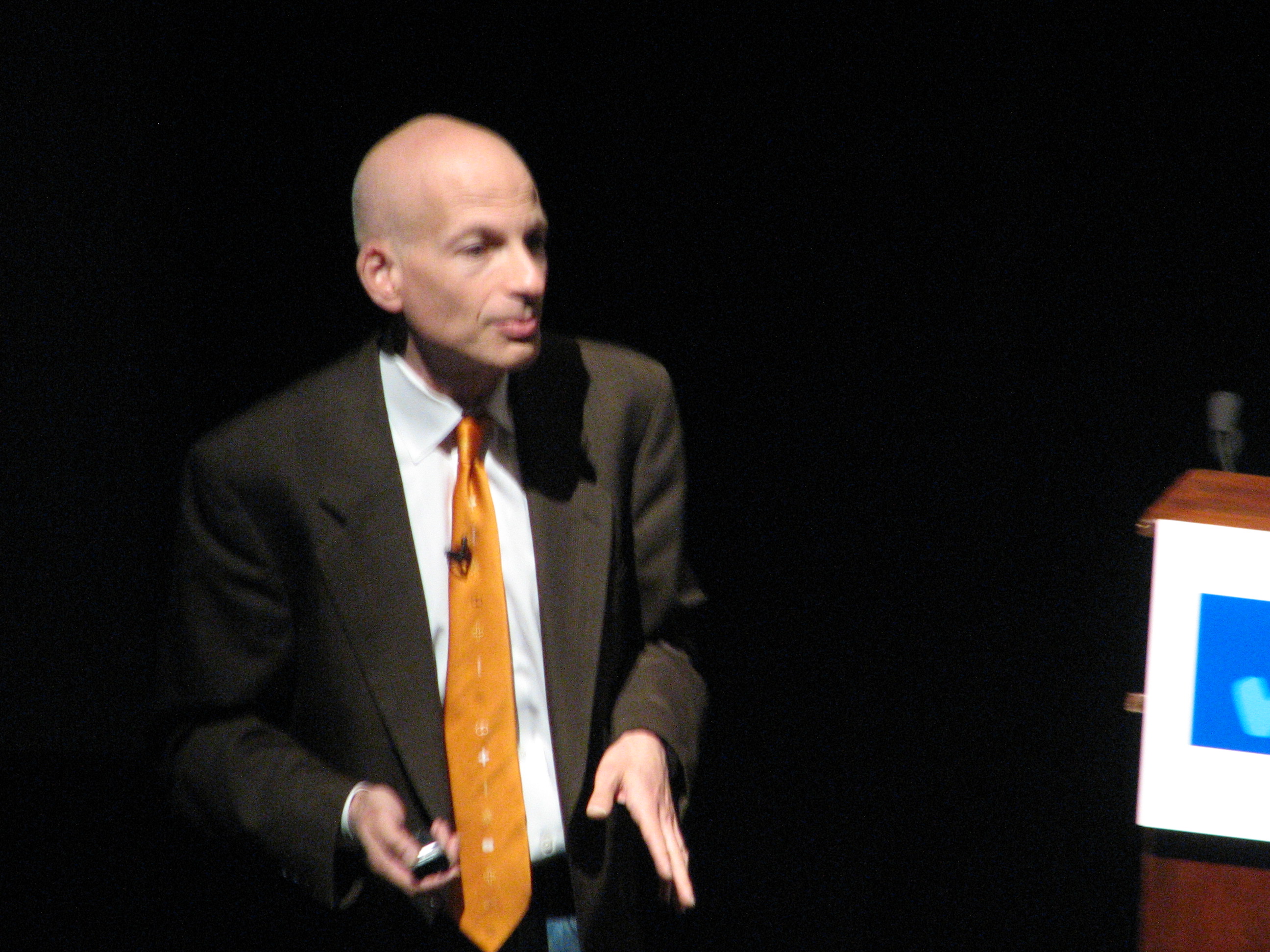
Godin isn't as bald as he appears in pictures. The white duck down encircling his head is trimmed close. Sinewy and alert, he is also gracious and relaxed and makes a habit of preparing his favorite lunch of brown rice, vegetables and a fried egg for guests who visit the apartment he has transformed into a homey office in downtown Hastings-on-Hudson, N.Y.
For the past three years Godin has continued to write his daily blog and maintain a lecture and workshop schedule. He has no full-time employees. When he needs help on a project, he taps a small circle of regular collaborators. He is not a Facebook fan or tweeter; he has no publicist. Books from his publishing venture The Domino Project, launched in conjunction with Amazon, did not have major publicity pushes or wide release at bookstores; instead, its provocative ideas spread virally, as the slim volumes were passed from one person to the next.
Seth Godin

With his new book, The Icarus Deception: How High Will You Fly?, Godin
 ends his self-imposed exile. Published by Penguin Group's Portfolio, the book was funded publicly via a Kick-starter campaign that raised $287,342 from

 4,242 people in 30 days. "I am more proud of this than anything I've ever done," Godin says. "Icarus feels urgent enough that I wanted to reach a group of people I can't easily reach with a blog post. And I wanted to be able to talk to those people with authority, so that they open up and give it a try."


Starting with this, his first-ever major magazine profile, Godin is aiming to connect with should-be, almost-are or want-to-be artists. They need to know, he proclaims, that this is their moment. "How many people get to go to work every day and say, 'This might not work,' and then go [do it]? The answer is, not enough," he says. "But it is going up. And that's what the book is trying to sell people. It is trying to sell them the joy of being able to say, 'This might not work.' Because it is so cheap to fail today compared to what it was to fail 50 years ago."
Success, meanwhile, has never offered more rewards. "We are paying people more money and giving them more freedom than ever before to make art," he says.
It isn't just painters and potters and poets. Entrepreneurs, marketers, crazy people who dance on street corners and anyone else who isn't afraid to express themselves has the opportunity to find an audience.
Seth Godin
"The sooner you deal with this and embrace it, the more likely it is that you end up on the side of the chasm with the people who can't believe their good fortune, as opposed to people who are cursing the darkness," Godin says, delivering his heaven-or-hell scenario with equanimity. "I'm pretty sure I'm right. What I'm not sure of is how long it will take and how unevenly it will be distributed.
"We've left the industrial era, the era of Mad Men, the era of 'Build a system, spend money and grow it,'" he goes on. "The recession is permanent. The cyclical one is over, but there is a permanent decline in industrial labor that is going to continue for the rest of our lives."
What we have now, he maintains, is a "connection economy," in which impresarios are the new big men on campus. "We are in an era of handmade insights, of human beings who touch other human beings in some way, making change happen."
As good as that sounds--and Godin assures it is good--such a change can be both disruptive and destructive. Expect collateral damage: Some people will not be able to make the shift from working for others to working for themselves.
All this is detailed in Icarus, which Godin describes as a "screed." But though written in his discursive, stream-of-consciousness style, the book is neither long nor a rant. It is Godin's clarion call, a public appeal to seize this moment of opportunity and riches before the barriers are rebuilt. If enough people make enough good art, impresarios might rule the world--an idea Godin finds appealing.
Walk into any book store and you will find titles promising to liberate you from ennui, a hundred fast rides to wealth and fame. The self-help guru of the moment is Tim Ferriss. His narcissist's guide to getting rich by working very little, The 4-Hour Work week, covers all the bases.
Godin's books take the opposite tack. Rather than "how to," they are "what is," capturing big-business trends in short, evocative phrases.Unleashing the Idea-virus (2001) is a strategy for inspiring change in society. Purple Cow (2003) discusses the power of being unique in a world of sameness. And Tribes (2008) explains the new ways we are organizing ourselves in a hyper-connected world.
Whatever the particular market phenomenon he is describing, Godin's central message is the same: Face your fears. Risk failure. Struggle. Persevere. Be free. He offers no short-cuts or detailed directions.
"Seth is one of the few people I know about whom I would be comfortable using the overused term guru," says Kevin Kelly, one of the visionaries behind Wired magazine and author of What Technology Wants. "Technically a guru is an enlightened teacher of wisdom, not a mere expert. Seth is a legitimate guru. He dispenses wisdom and teaches wisdom. He is forever reminding everyone of the unchanging truths, and then overturning everything else, and constantly questioning his own--and your--discernment between the two."
Michael Wayne was building his digital media company, DECA, when Godin released Tribes. "He captured what we were thinking and experiencing before anyone had a name for it. I bought the book for everyone in our office," Wayne says.
Godin calls himself a teacher. He'd rather give his students a compass than a map. "I'm trying to say to people, just for a minute: Put on a set of glasses and see the world as I imagine it," he says. "Does it work for you? Does it feel right? Does it make sense? And, if it does, don't do what I just said to do--that's a cookie cutter. Invent your own next chapter. "
Seth Godin

At the time Godin started writing, his students worked in office buildings for companies with big marketing departments. Today he speaks to individuals

who embrace what he says about the post-industrial world and are eager to leave the platitudes of the corporate world behind.

The ubiquitous checklist of "foolproof" steps to solve problems is "an easy sell," Godin says, "but it isn't true." More important, "it isn't going to put a dent in the universe. The way you make something happen is to do something that a fool could screw up. These things aren't foolproof. They are risky, scary. They require vulnerability and a willingness to be in the world."
Buffalo, N.Y., in the 1960s was a painful obstacle course for a scrawny kid growing up with what he now thinks was attention-deficit disorder. Everyone played hockey, so Godin did too, despite heart-stopping fear of being slammed into the ice. And everyone went to summer camp, so Godin's parents sent him off to Camp Arowhon in northern Ontario. "I didn't like it much as a kid," he recalls. "Camp was about fitting in, and there was a fair amount of bullying." He stuck it out, though, finding his niche as a canoeing instructor.
Godin's job wasn't just to teach canoe tricks--he had to convince campers to do that instead of horseback riding or swimming. "Canoeing was hard and scary, and the wind could blow you across the lake if you did it wrong," he says. "After a year of not doing it right, I could talk to people and get them to sit up straight, take different kinds of chances, to breathe differently, to engage in the moment in the boat. And I changed them, and I changed me in the process. I did it for five or six years. I was really good at it, and I really loved doing it, and I've been trying to re-create that ever since."
After graduating from Stanford University's business school in 1984, Godin started a book-packaging company, peddling finished concepts to publishers. He had an early success, followed by 900 failures. Then, he says, he found his groove, before completely screwing up.
"This T-shirt here is one of my most treasured possessions," he says, pulling out a garment featuring the cartoon face with round glasses that has since become his logo. "Forty billion dollars is what this T-shirt is worth."
In the early 1990s, before the online world had fully formed, Godin snagged a magazine assignment to write about "cool things" happening on the internet. He parlayed that into an $80,000 book deal, Best of the Net. The T-shirt was part of the package. "I hired a lot of people," he says. "It took six months. We made a 250-page book, and it sold less than 2,000 copies." At the same time, "Jerry Yang and David Filo saw what was going on with the net and said the best way to tell people is to start a search engine. And they started Yahoo.
"I knew what they knew," he continues. "I had the resources they had. And I created a book that sold nothing, and they created a company worth $80 billion. I figure I would have had half of that, so that is why the T-shirt is worth $40 billion."
It was an invaluable lesson, says Godin, who went on to launch Yoyodyne, an internet marketing company he sold to Yahoo for some $30 million in stock in 1998, when Yahoo shares were rising $2 per day.
Seth Godin
Yoyodyne was a scrappy little company that punched above its weight. When everyone else was treating internet users as a commodity, Godin preached relationships. "Seth likes to say there are two ways to get married," says Michael Landau, a colleague at Yoyodyne who became vice president of brand marketing at Yahoo and is now CEO of Drybar, a chain of chic hair salons. "You can go up to every single girl you meet and hope that you get some random sucker who agrees to do it, which is what traditional advertising does, or you can take a more methodical approach: Ask someone out on a date first and get to know them. Then another date. And, eventually, get married."
Yoyodyne, Landau adds, was an "intoxicating" experience. "The world was changing in a big way, and no one knew what to do. Desperate is probably the wrong word, but clients were anxious and grateful for someone helping them figure it out."
Godin needed a way to explain exactly what he did for clients. "We weren't selling ads, so what were we selling?" he recalls thinking. "I got in the shower one morning and didn't get out until I had my answer. Just as the hot water ran out--15 to 20 minutes--I had it. What we do is 'permission marketing.' We deliver anticipated, personal and relevant messages to people who want to get them." He laid out the philosophy in Permission Marketing.
"Seth has created his own school of marketing," contends popular Silicon Valley blogger Guy Kawasaki. "He doesn't fit into anyone else's. He's all about clear differentiation, permission and not asking customers to do something that you wouldn't do."
Landau calls Godin a mentor who "truly changed the trajectory of my career and my life." That said, he adds, Godin "can be the most frustrating person because he really makes you think. He is never going to tell you what to do. He is never going to give you the answer. He is going to steer you in the direction to get there."
At Drybar, Landau has been struggling to control costs, in particular the cost of taking phone reservations. He was thinking about offering $1 off to anyone who booked online, but Godin's advice changed his mind. "Double what you spend on telephone operators," he told Landau. "Encourage customers to call in--these people love connecting with your brand. They are your evangelists."
Landau says those words "completely shifted" his thinking. Indeed, "Never squander your relationship with your customer" has been a Godinism for 20 years.
A year after the Yahoo buyout, Godin left Silicon Valley to live a writer's life in the Hudson Valley, helping people improve their marketing skills. "What's really cool, which I didn't plan on, is that it applies to people way down the hierarchy of scale and profitability," he says. "It applies to second-grade teachers, a waitress in a restaurant who wants her tips to go up, or musicians or painters who want to make a living. And that's all new."
Seth Godin


Indicating a giant compilation of the best of his blog posts, a gift to the Kickstarter investors in the project, Godin says, "The name of the book is This Might Work, but if you turn it over, the back cover says This Might Not Work. And if you open it, you see a list of all of my projects that have been complete failures. You have to embrace the stuff that doesn't work or you don't get to play."
But if you can accept that, and you offer your art to the world, Godin contends, life improves. New things are possible--witness the artisanal revolution that swept through the food world a couple of years ago. Mass-market producers like Procter & Gamble are losing more shelf space to impresarios every day. "If it isn't going to happen in your industry, then your industry is dead, and you should get out of it. It will downsize and cost-reduce, and you can't win there," Godin warns.
"The connection economy creates abundance," he notes. However, "there are not going to be jobs like we used to think of jobs. Those jobs are going away. But the number of opportunities for tribe leaders goes up." This is because the connection machine and the marketing machine and the announcement machine that is the internet allows everyone to create.
"I can't even go to the edges of how revolutionary this all is, because people can keep coming up with stuff that is even closer to the edge," he says. "The thought that there will be franchises where there is no franchisor isn't that big--it is only two years from now. The idea that if you can't get on TV, you will make your own show and broadcast it is happening right now. No matter what field you are in, your bluff is called. You can no longer point to boundaries that are there, because they are pretty easy to surmount, if you want to.
"In 1918, the one thing you wanted to hear was 'Make sure you have an assembly line. Make sure you have mass production.' In 1950, the one thing you wanted to hear was 'Buy more ads.' [Now] the only thing you need to hear is 'Be more generous. Make more art so that you can be trusted.' If you try to maximize those things, everything else will take care of itself."

Postscript: I approached the research and writing of this profile wearing two hats. I was both a journalist and an entrepreneur. My standard curiosity spiked with skepticism made room for a bit of optimism that perhaps I'd learn something that would help me build Zester Daily, the journalists' business cooperative I founded.
I asked Godin about skills, talent and connections. "If I were talking to people who are diamond-cutters or cardiac surgeons, I think we can agree that skill first, second and third are all I care about," he said. "But almost everyone who is making progress in today's economy isn't doing something with a certified skill. So the skills we are talking about are the skills to connect with people, to see the world as it is, the ability to imagine a different place you would want to take the world. These are fundamental human skills, not something you learn at Harvard."
I asked about money. "Anyone subscribing to this magazine has enough resources to put something into the world and see what happens. It has never been easier," he said. "We just connected you to a billion people for free. It costs you nothing to start that eBay business. If no one buys your stuff on eBay, then don't sell it. It costs you nothing to buy Google Ads. If no one clicks, you don't have to pay anything. It costs you nothing to have a blog and give away every secret you know. If no one reads it, nothing happens."
The thought of failing makes me sad, I told him. "If Zester doesn't work, it will be because you have been protecting yourself from being sad," he said. "Art is painful. Bob Dylan got booed offstage when he went electric. He got booed offstage when he went gospel. The Monkees never got booed offstage."
Then I asked about finding an audience. "Generally, the tribe finds you," he said. "If they are hiding, you are never going to find them. And if they find you, it is because you are being generous to others who are in your tribe. Generosity in the industrial setting means giving them stuff. But I'm talking about giving them kindness and attention and connection.
"I thought what was neat about Zester," he added, "besides the writing being really good, is that the tribe of people who are going to spend the time reading is exactly who a certain group of people need to reach with their advertising. But they aren't going to do it willingly. They are only going to come along after you are so dominant in the space that they have no choice. The key is, if every one of your users gets you 10 more, and you do that three times, then you win."