Showing posts with label creative process. Show all posts

Leaders Fight for Their Creative Vision

I recently watched the movie, "Saving Mr. Banks," a Walt Disney film that shows the process that Walt and Mrs. P.L. Travers used in creating the movie "Mary Poppins."

The thing that stood out to me the most is that the creative process is messy, yet, it's full of joy and happiness. The creative process is frustrating and rife with obstacles and barriers, yet, it's inspiring and uplifting, as well. There is constant starting, stopping, redoing, and editing that drives you mad, yet, it's collaborative and spirited.

To get the through the creative process it takes all of the above and it takes a leader who is committed to his vision; a leader who has his mind set on bringing his vision to life. It took over 20 years for Walt Disney to convince Mrs. Travers to allow him to make a movie from her book... at one point, Mrs. Travers stopped the whole creative process and went back to England, refusing to go any further.

At this point, Walt had a choice to make, he could have thrown his hands up in frustration and shut the whole project down or he could fight for his vision by going to England and trying to convince Mrs. Travers one last time. It probably comes as no surprise that Walt persevered; he took a trip to England to visit Mrs. Travers so he could make one last attempt at convincing her to let him turn her masterpiece into a movie that would be enjoyed by millions of men, women and children. The rest, as they say, is history.

The key to Walt Disney's success was his ability to persuade and persevere through all types of barriers, obstacles, and hardships. Yet, through it all, he remained true to his vision of turning Mrs. Travers' book into a cinematic work of art that garnered over 20 prestigious movie awards and was rumored to be his favorite film out of all of his classic movies.


https://ezinearticles.com/?Leaders-Fight-for-Their-Creative-Vision&id=8405352

Relaxation As Part of the Creative Process

High-Angle Photo of Person Wearing Sun Hat

The creative process is a series of flows going and coming from different directions. Some flows come from sources of inspiration, go into the artists mind and flow out from the artist and into the audience. Other flows encircle two fellow artists, while others come from fans to the artist in the form of support, admiration, or income.

But as far as the act of creation is concerned the flows that go through the artist sometimes become problematic and cause difficulties. The artist takes elements they perceive in the environment and fuses those elements together in unique ways with emotional aspects of their psychology derived from their philosophy of life. They combine these factors with the work of their hands using earthly materials to create aesthetic products.

The flows and the process of creation form a system and like other systems they can get damaged or break down. The reasons vary greatly from one artist to another as to why damage or corruption causes the system to slow or fail altogether. Failing altogether isn't as common as slowing or burning out, which is typically caused by the system running or flowing in one direction for too long.

The body and mind are an interface that works well in harmony to control the flows from the environment and the mind as they move through the body. Interestingly, the environment and the mind are constantly emitting impulses or providing stimuli to the body via the nervous system, which consists of the electrical circuits that run throughout the body. The mind is constantly providing orders to various body parts to get them to do its bidding while the environment is a gigantic theater of sensory input without end.

This makes the body a conduit for the flows going in to the mind from the environment and back out to the environment and from the environment coming in to the mind and back out from the mind to the environment. The mind can also provide its own stimuli in the form of inspiration, memories, dreams, and ideas-realms of creativity-which also flow through the body, out to the environment, and back in again.

All of this flowing and non-stop sensory input keeps the body in a state of enervation, which causes damage, slowing, overloading, and burn out. Enervation is simply when the body feels drained of energy or experiences exhaustion from too much stimulation (overloaded circuits).

Physical Relaxation

For artists, relaxation is the only method of reversing the effects of enervation and is therefore a vital practice to achieve creative longevity. The use of drugs (illegal or prescription) or hypnotism is no substitute for relaxation. In fact, they are in themselves additional forms of stimulation and sensory input that would further agitate the body in a state of enervation. Avoid them if possible when relaxation is required.

Exchanging one form of stimulation for another doesn't constitute relaxation. Like the alcoholic who exchanges one drug with another by replacing alcohol with nicotine or caffeine, they are merely switching one addiction for another. Such compromises bring about new problems and the individual remains an addict for the whole of their lives without really living drug free.

True relaxation means refraining from artificial forms of stimulation and sensory input to experience one's self and one's environment in a natural state. When the alcoholic switches to nicotine or caffeine, they are actually mitigating the effects of withdrawal by forming new addictions.

For the drug addict, going through withdrawals is actually the gateway to living drug free. Withdrawals are actually the body's method of removing drug toxins from its systems so that they can be expelled as waste products. This along with other therapeutic techniques is what finally allows a person to eventually arrive at a drug free existence.

Similarly, the artist can recuperate from the artificial forms of stimulation and sensory input derived from the creative process by going through a kind of withdrawal. Because each form of artistic labor will have its own particular challenges to achieve a state of relaxation, each type of creative work will have its own form of withdrawal and will require the invention of strategies to remove the unique stresses that are specific to that art form.

For the chef, try a period of eating only pure flavors to help you relax your palate. This would comprise eating only raw fruits, slightly cooked vegetables, and meats or starches with little or no seasonings at all. Periodic short or prolonged fasts might have the most benefit in the long term to keep the palate sharp and the digestive system strong.

For musicians, go with a period of quiet. Because we exclusively use our ears to find, test, and combine new sounds, it's our ears that suffer the most stress during the creative process. The height of tall buildings and the remoteness of the mountains will help you rise above the sounds of cities and human life, while the distance and expanse of wide open spaces in the desert, grasslands, and bodies of water will bring you peace through extremes of noise reduction.

In contrast, relaxation for the athlete and dancer might consist of either active or passive processes such as resting or stretching depending on the movements they are normally performing.

For the illustrator and painter relaxation might actually pertain to several practices to resolve several issues. Stretching might work to help relax the effects of restricted and repetitive movement, while meditation (sitting with eyes closed or in a pitch black room) will work to de-stimulate the eyes.

Notice how relaxation actually constitutes sensory deprivation of one or more of the senses. The reason is because what we're trying to resolve is enervation (chronic nervous stimulation), which can only be alleviated with its opposite: sensory de-stimulation or deprivation. Other approaches for achieving sensory de-stimulation will include noise cancelling headphones, a sound-proof chamber, meditation, dim lighting, a walk in the forest, travel to a secluded out-of-the-way location, and extended time in an empty house or hotel room.

The purpose of all these approaches is to greatly reduce the amount of stimulation our brains and bodies undergo during the creative process because the focused effort of the act of creation almost always comes at the expense of our body and its need for relaxation. But much more important than the purpose is the effect we are trying to achieve which is resetting or refreshing our senses, so as to return to our work with "new eyes."

Mental Relaxation

Resolving enervation and the physical toll it takes on our bodies is just one component to achieving complete relaxation, while altering mental function will be the other. Sensory deprivation will help alleviate the accumulated stress collected in the nerves of the body, but what about the accumulated stresses in the mind. Just as the creative energy of the body can slow or burn out by flowing in one direction for too long, so can the function of the mind in the creative process.

The focused intensity of the act of creation usually comes at the expense of our minds, especially when our attention acts in a single capacity or mode for too long. Ironically, sensory deprivation will not assist the mind in its ability to refresh itself, because the senses are not its only channels of stimulation. Dreams, creativity, and imagination are unique aspects to the function of the mind and require a different approach when trying to achieve mental relaxation. However, the same principle still applies when dealing with the issue of relaxation.

Just as we resolved burn out caused by excessive or prolonged sensory input, the mind can also be helped. The focused intensity of creative thought can be relaxed by "free thought" because focused intensity and unregulated thought energy are opposite forms of mental activity, which means they can be used to counteract one another. In other words, structured or guided forms of thinking can be relaxed into more fluid or "free" forms of thought.

Within each artistic discipline these forms of mental activity express themselves as extremes such as the difference between the novelist and the poet in writing, the realistic painter and the abstract painter in painting, the ballet dancer and the modern dance performer in dance, as well as tonal and atonal or microtonal music in composing.

Sometimes stretching oneself as an artist can be a form of relaxation, but only if you explore an opposite artistic extreme than what you're normally used to. So if you tend to write in more structured forms, relax by attempting to author a bit of poetry and vice versa. This stretching technique can also be a great benefit because it allows you to find new material to bring into your normal creative mental function.

Improvisation and accidental art approaches are also interesting areas to explore because they combine what we know or have learned with expression without the need to necessarily create something with structure and conscious intention. In other words, approaching our craft with the skills we've acquired but without the goal of creating structure is a form of relaxation for the creative process by getting us to act more spontaneously. The openness of mind required in these approaches slackens the desire for creative outcomes to turn contrary artistic efforts into relaxation techniques. The contrasts and deviations of approach between each pair of opposite as shown above actually holds the keys to therapy within each art form and medium.


https://ezinearticles.com/?Relaxation-As-Part-of-the-Creative-Process&id=9427165

The Birth of Creative Work (By Sarah Koestner)

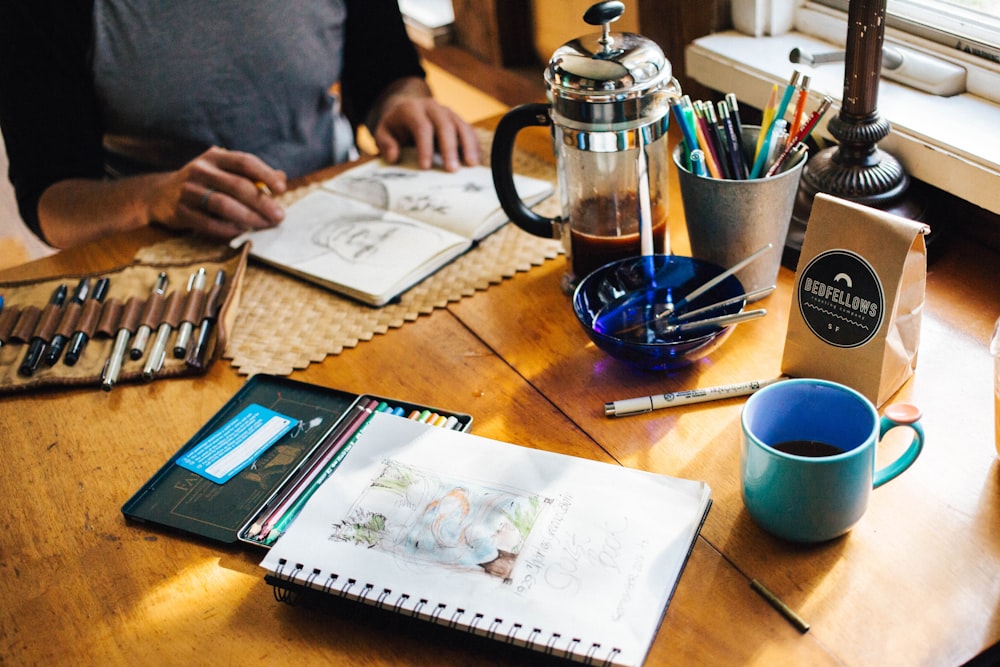
person holding book with sketch

A few weeks ago I started taking a weekly art class. It's been great for me to connect to my creativity in a structured way. I have learned so much about my creative process and I've only been in the class for 3 weeks! I can't wait to see what else I learn over the next couple of months.

This week in class the focus was portraits. The instructor had us put a big blob of red paint in the middle of our paper, which was used to create the shape of the model's head. She told us to use black and white paint to convey where light and shadow were hitting the model. We had 15 minutes to complete the painting. The idea of this exercise was to work quickly and not get bogged down by thinking about each brushstroke.

We did three of these 15-minute paintings over the course of the class. Each time, mid-way through, I was convinced I was doing a terrible job and I should start over. (There's that sneaky inner critic again!) However, instead of crumpling up my paper, I breathed through the discomfort and finished each painting. And guess what?! A face emerged on the canvas. I started each painting with a big blob of paint in the middle of the paper and over the course of 15 minutes somehow I created a portrait. In a way, it was magical.

It got me thinking. When I'm in the middle of a rehearsal process I often go through a similar experience. I start off the project excited about the possibilities and happy about the chance to create something new, but in the middle of the process, I sometimes feel lost. Everything feels muddy and uncertain. It's a very uncomfortable time, often filled with self-doubt. It can feel as if you are eight months pregnant with your creative work, awkwardly lumbering about, anxiously waiting to give birth.

What I've come to realize is that the middle of the creative process is very much a liminal zone. Liminal is defined by Merriam-Webster as "of, relating to, or being in an intermediate state, phase, or condition." Liminal zones are transitional times in the human experience when we are neither here nor there. Examples of common liminal zones are: graduating, moving, starting a new job, getting married, being pregnant. These are often challenging times in our lives, filled with uncertainty and discomfort.

My thought for you today is to realize that the middle part of any creative process is a liminal zone. It's okay that in the midst of creation we are uncomfortable-- you could even say that it is natural or inevitable. You will get through it. Trust that you won't stay there forever. That "in-between place" is simply a part of the creative process. It is a necessary part of your art being "born." And while that is sometimes an uncomfortable, and even painful process, it is also necessary. We can't NOT create in order to avoid the discomfort. The consequences of denying ourselves artistic expression are simply too high.


https://ezinearticles.com/?The-Birth-of-Creative-Work&id=9218750

Share Your Talent With the World


Woman Wearing Black Sports Bra and Jogger Shorts Smiling

Share your talent with the world. Don't be timid or selfish. Be bold and daring with your talent--all of it.

Fear is a threshold you must overcome. We need your talent in the world, now. Why are you stalling?

We depreciate ourselves during our creative process; yes, we all go through this sporadically while we are developing our dreams into reality.

Artists, writers, photographers, authors, speakers, farmers, business owners, musicians, scientists, gardeners, dancers, singers, actors, chefs, athletes, filmmakers, comedians, and in every field people are striving to make things better, to find an improvement, to make things unique, to change outcomes, to offer loftier products and services, and to turn the world into a more hopeful place.

In addition, everyone has a level of doubt about his or her work at times.

Writers, poets, and authors do not stop writing because previous talented authors such as Jack London (journalist and author), William Wordsworth (English poet), and Henry David Thoreau (author), were already discovered.

Artists and photographers do not put away their tools because Frederic Edwin Church (Hudson River School artist), and Ansel Adams (photographer), were already well-known as the pinnacle in their field of expertise.

Athletes train to exceed the current standard of performance and to surpass their own as we noticed with sisters Venus and Serena Williams, both ranked number one during their tennis careers at times.

Michelangelo did not begin painting the Sistine Chapel on his primary attempt; he had a lifetime of artistic skills developed through commissioned work he produced over his career.

Yes, superstars are intimidating; they set the gold standard in their industry for all of us to challenge ourselves and one another in becoming a sterling example of creativity and proficiency in our field.

On occasion, some people seem to have genes that come with a high level of expertise and skills already built-in, a prodigy or teens with awesome talent. Generally, this is not the course of progress.

The reality is once you master one level of skills in your field, you long for a greater level and a more proficient way to perform. Goals are reachable, then we struggle to attain and achieve even more. A level of enthusiasm and momentum grows with each success.

Once we build a foundation, a level of confidence develops through 'wins' both minimal and great.

Do not hesitate to create your ideas. The time is now. You will change the world in a positive form that is unique with your creative viewpoint. Share your talent with the world - all of it; we are awaiting your creative ideas to make the world a more hopeful place.

"Don't ask yourself what the world needs. Ask yourself what makes you come alive, then go, and do that. Because what the world needs are people who have come alive." --Howard Thurman.


https://ezinearticles.com/?Share-Your-Talent-With-the-World&id=9186254

Understanding Creativity - With Neuroscience


Neuroscience is shedding light on many areas of human behaviour - including the creative process. So is it the case that you are either a creative person, or you are not? Can our developing understanding of the creative process help us become more creative? How does it work?

Behind almost everything we do and say is a creative thought. From the car we drive to work to the sandwich we eat for lunch and the movie we watch in the evening - it all started with an idea.

And in the workplace, solving problems often requires creative thinking. We therefore owe it to ourselves to understand creativity better.

The creative brain

The creative process is not centred on a specific area of the brain; rather, creative thoughts are a result of neural activity in several different cerebral regions.

There are generally considered to be two stages to the creative process:

  1. Experimentation and the creation of new concepts or works
  2. Rehearsing, editing and assessing the final product

To further understand this, we need to consider several of the brain's networks thought to play a part in the creative process.

The 'executive attention' network

Some creative tasks involve intense concentration; this calls for the 'executive attention' network to be exercised.

This controls attention and working memory, and is often more active in the rehearsing, editing and assessing stage rather than the initial experimentation stage. It adds extra focus to the final touches.

The 'default' network

Allowing freedom of the mind to be distracted and to 'wander' is another important part of creativity, where the 'executive attention' network is less influential.

Here the 'default' or 'imagination' network might take over, where daydreaming and removal of focus on the outside world becomes key. This helps in self-reflection and recalling past events, helping us build new pictures based on previous experiences.

The 'salience' network

The 'salience' network helps the brain decide which sensory inputs to pay attention to and which to ignore.

It is thought to help us 'switch' between relevant networks of neurons, turning the most appropriate groups on or off, depending on the situation: we might need the 'executive attention' network or a freer flow of creative thoughts based on emotions and sensory inputs, depending on the task at hand.

Clearly, composing a piece of music or drawing a picture requires different creative skills to solving a complex problem in the accounting department at work.

It is therefore not surprising that we use different parts of the brain to help us achieve them, though each could be said to require a 'creative' response.

Some creative tasks require a high degree of 'latent inhibition' - the ability to filter out the surrounding world - for example when writing an important report; others thrive on the distraction that seemingly 'irrelevant' inputs provide. Similarly, some tasks require extensive self-monitoring and control of actions, while others (like performing a jazz improvisation) will actively suppress it.

Clearly, the creative process is complex and neuroscience has just started to shed light on it. There is a long way to go, but it is sure to be an interesting journey.


https://ezinearticles.com/?Understanding-Creativity---With-Neuroscience&id=9351147

Catharsis and the Creative Process

Person Coloring Art With Crayons

Creativity is the most intense path to catharsis. The mind must connect to the emotions and form an idea into a physical shape such as a book or painting. The mind and the emotions must unite into a single line of intention that fills the work of art completely. Similarly, the artist's body and his equipment must become one in a singular creative purpose.

Whether it's a new recipe, clothing design, or symphony, the creation must receive and retain the full intention of your concentrated effort. The result of any act of creation should always be the physical form of an aesthetic desire, which is the drive to see something become real that only exists in your imagination.

Every creative idea an artist can conceive of has an energetic center of gravity that pulls similar energies like it towards itself. So as we fill an aesthetic product with our desire to make it real, it forms a vacuum within us that is steadily filled with more ideas similar to the original. The human experience of this creative vacuum is felt as a surge of inspiration or illumination in spiritual circles. Others report it as a spiritual awakening, the seeing of transcendental visions, or catharsis.

As the inspiration fills us, it disturbs our balance of mind by generating wild undercurrents in our consciousness that eventually must find resolution in our work. This experience has many names because no one really knows it's true source, so each person attributes it to the source they most deeply value. But whatever the source, supernatural, extraterrestrial, or earthly, the human mind is the vehicle or conduit for the creativity that is flowing through them. To channel the complete creative desire into art is the nature of our work as artists.

To tap into this stream of creativity, the artist must treat his work as if it were a ritual or ceremony that deserves his utmost respect. He must enter a state of relaxed concentration and allow the ideas to pour through him and connect to his emotions in order to translate them into artistic products. Sometimes the creative stream is light, heavy, or overwhelming depending on many factors such as the time of day, our mood, the seasons, and our level of skill, but neither resistance nor total acceptance will prevent the eventual burst of catharsis, which restores balance to the mind.

The more expertly and efficient the artist can work, the quicker they can complete each product and prepare it for distribution. In the end, the ultimate goal for most artistic endeavors is to form our creativity into a physical shape. All of the objects that fill our world have been brought to us through the creative process and the work of human beings to make it solid and real.

For musicians, the goal is to shape an idea, message, or emotional experience with sound and solidify it in a recording. For an author, the goal might be to formulate a plot line complex enough to keep the readers guessing, while permitting various clues to surface throughout the story that make the readers believe they know who did it or what's going to happen next. For the entrepreneur, the goal will be to manufacture the good or develop the service to reach a targeted set of customers or clients. And for a singer, the goal could be to present lyrics with the correct balance between technical delivery, emotional display, and theatrics.

As the facet of our creative energies must be opened and closed for each work of our imagination, you must complete the creative process with the belief that the work you have done has assumed the physical shape of the idea you had been operating towards, and that there's nothing more inside of you to put into it. With balance of mind restored, the cathartic release subsides, and allows you to review the work you have just completed. The law of catharsis requires that you consider it done and never return to it again.


https://ezinearticles.com/?Catharsis-and-the-Creative-Process&id=9427138

How To Think Creatively Instead of Randomly


The first thing to understand about thinking is that "you" don't do the thinking. Thoughts spring up from the subconscious on their own, and you just observe them then accept or reject them. We're talking about those endless, seemingly uncontrollable, random thoughts that flit across the screen of your awareness every day. These are noisy thoughts like static electricity that we practice meditation to control and quiet. These thoughts are generally unproductive and non-creative because there's no purpose or meaning behind them. They're just a part of the landscape of a currently idle rather than a seeking or creative mind.

As soon as you add purpose to the equation the creative process can begin. Purpose means you want to answer a question or solve a problem. You take the question from your conscious mind and turn it over to the subconscious mind to provide that answer.

Here's where faith comes in. You have to have faith that the answer is already within you -- within your subconscious mind. And you will have that faith because it's based on the fact that you could not have possibly come up with the question if you didn't already have the answer within you. It takes the one to create the other. That's how the mind works.

So, convinced you have the answer somewhere within you, you just patiently observe or listen to what now issues from the subconscious. You still have to be selective and discriminating, but at least now you know what you're looking for. Now you have a plan, a method. What you'll now get will not be all useless thought but some intelligent, intuitive thought. Intuition doesn't come in words; it comes in a silent knowing. You now know the answer. Then you can turn it back over to your conscious mind to put into words.

While you'll definitely get the answer you're seeking, it's not definite how long it'll take. Could be hours, days or weeks, depending on how apropos the question to your problem, and whether you formulated the question correctly, etc. This is where detached patience and perseverance come in.

Let's say, for example, you want to write a detective novel. All you have so far is the price -- $25 in hardcover. It's a start, and you can almost see your name in lights on the marquee when they turn it into a movie. Many questions will now arise. What's the title? What's the plot line? Who are the major and minor characters? Who's the perp and why did he or she do such a dastardly deed? What's the theme of the story? The period and setting? The conclusion?

The answers to all these questions are in your subconscious mind at the very moment you pose the questions. Thus no stress and strain should ever be involved in the creative process. Stress indicates you've forgotten or have lost faith that all the answers are within you right now.

As many questions will arise during the planning of the novel (or business, etc.), many more will arise during the actual writing of it. Let's say you, the author, are totally stuck and blocked as to what the detective hero should, would or could do next. You form each "problem" into separate questions and turn them over to your subconscious.

The intuitive solution that soon springs up may go something like this: You let the detective feel exactly as you, the author, are feeling. Let the detective feel depressed and confused as to how to proceed - just as you are. Let the detective fear being out of leads and clues - just like you are. Let the detective start doubting himself and thinking about seeking some solace at the bottom of a bottle of Jack Daniels -- just as you the author were thinking. Continue in this vein to the compelling final resolution of the story - a resolution that's just as much a surprise to you as to the reader!

Had the author tried to think out this project "on his own," it's unlikely he would have come up with such a brilliant approach to it or "created" it with such ease and originality. The novel virtually wrote itself. It's amazing.

http://ezinearticles.com/?How-To-Think-Creatively-Instead-of-Randomly&id=9333201

How to Do What You Love and Get Paid For It – In 4 Simple Steps

                  
I have a friend who makes most amazing clay mugs in her spare time. She’s a legal advisor, but her dream is to make a living from designing clay mugs.
Her mugs are so beautiful that undoubtedly I would be her cheering customer. Yet, she doesn’t see mug making as a profitable occupation – a “realistic” profession in a legal field sounds safer.
The same goes with many people. It’s saddening to see human beings laboring in occupations they have no heart investment in, and it’s even sadder that they believe they can’t make their hobbies into profitable occupations.
It’s not necessary to spend entire lives slaving in occupations we don’t enjoy – we can easily do what we love, and get paid for it.
Here are the 4 steps that will help you do just that.
1. Transcend the common opinion
It’s harmful to subscribe to society’s standards of how people should be like and what’s considered “success”. As a result of this conditioning there are many broken lives. The societal pressure convinces us through fear-based “evidence” to choose profitable occupations at the expense of soul finding and inner fulfilment.
Transcend the common opinion. Free yourself from damaging media suggestions, fear-based parents’ advice and prejudiced friends’ opinions. You are a limitless being free to realize yourself at this moment. You don’t need to seek permission to do your heart’s work from anyone but yourself.
I don’t have qualifications to teach people or to inspire people, but I’m doing it. Nobody gave me permission to become a blogger or even believed I could become one – but I’m blogging for 6 years now, absolutely loving it and prospering from it.
Transcend the common opinion. Do what feels right, what you love. 
2. Believe you can
If you don’t believe in yourself, others will surely not believe in your ability to achieve goals. You’ll give off the vibe of failure, and repel people who would be your perfect customers/partners and other supporters. Money materializes in your life through people paying for your goods and services, so it’s vitally important to leave the first impression that says “success”.
Believe in yourself – you start believing in yourself when you accept yourself fully. Lovingly accept your imperfections knowing that were’ all imperfect. That, of course, shouldn’t discourage you from improving yourself – it’s actually easier to improve yourself when you fully accept your current limitations.
3. Trust the creative process
That’s probably a harder step for most – it surely was for me. It took me a long time to fully trust the creative process, sometimes even now fear tries to grip me with questions such as:
“What if nobody will come to my workshops?”
“What if something goes horribly wrong and I lose all blog’s data and it would not be recovered?”
“What if nobody orders my ebooks or coaching?”
Once I get such thoughts, I externalize them as not mine but coming from societal beliefs. It’s a widespread belief that small businesses can hardly survive these days and that entrepreneurial work is too risky. I thank the fear for sharing humanity’s beliefs and then focus on this affirmation:
“I fully trust the creative process. I know that by trusting this process I’ll always be in the right place at the right time, getting exactly what I need for my personal growth.”
It works every time.
I hope you will come up with an equally empowering affirmation to counteract discouraging moments testing your belief in your Self and your goals. You can use this one if you find it inspiring, of course!
4. Create massive value and charge less for it
When you find the work that you love, believe that you will succeed and fully trust the creative process, it’s time to create massive value and charge less for it.
That’s how people continuously prosper – through giving more than people pay for. The best model is to create so much value for free that people cannot help but pay you in any way they can to say thank you, and to make it easier for them to say thank you by creating products or services to pay for. Blogging provides an ideal prospering model, therefore.
This kind of giving will generate so much talk about you that you’ll prosper through all the referrals alone.
And even if your work isn’t available for free but you charge less for what your wonderful products and services are worth, you will still prosper. It’s not my idea of how to become abundant – great business leaders have exactly the same opinion; Henry Ford comes to mind as someone who always emphasized this law of abundance.
Conclusion
By applying these four straightforward steps…
1. Transcend the common opinion
2. Believe that you can
3. Trust the creative process
4. Create massive value and charge less for it
…you will stop slaving for money without heart and will start creating because you love to do so, whilst getting abundantly rewarded for your heart’s labour.
Doing your heart’s work should be everyone’s top priority, and the more people would do it, the more compassion, happiness and meaning there would be in the world.