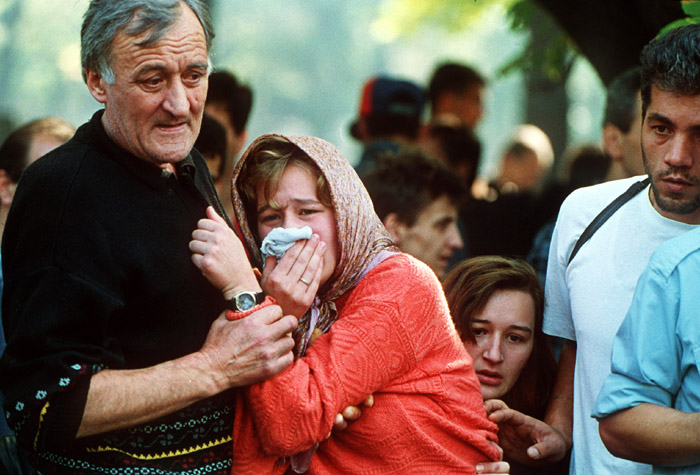
No one questions the value of feeling good. In fact, it seems that for the past 20 years, everyone in America has been on a relentless quest for a blue-sky state of mind, in pursuit of permanent residence on the spectrum between contentment and ecstasy.
Feeling bad is another matter entirely. Emotions that generate unpleasant feelings have been called sins (wrath, envy), shunned in polite interaction (jealousy, frustration), or identified as unhealthy (sadness, shame). We suppress them, medicate them, and berate ourselves for feeling them.
Because such feelings are aversive, they are often called "negative" emotions, although "negative" is a misnomer. Emotions are not inherently positive or negative. They are distinguished by much more than whether they feel good or bad. Beneath the surface, every emotion orchestrates a complex suite of changes in motivation, physiology, attention, perception, beliefs, and behaviors: sweating,laughing, desiring revenge, becoming optimistic, summoning specific memories. Each component of every emotion has a critical job to do—whether it's preparing us to move toward what we want (anger), urging us to improve our standing (envy), or allowing us to undo a social gaffe (embarrassment).
We have the wrong idea about emotions. They're very rational; they're means to help us achieve goals important to us, tools carved by eons of human experience that work beyond conscious awareness to direct us where we need to go. They identify trouble or opportunity and suggest methods of repair or gain. They are instruments of survival; in fact, we would have vanished long ago without them.
Negative emotions are not only crucial to our existence but also—ironically—to feeling good. To live optimally in the world and endure its challenges, it's necessary to engage the full range of psychological states we've inherited as humans.
"The science of well-being has forgotten that the world is an uncertain, complex place filled with people who often are annoying and obnoxious," says Todd Kashdan, a psychologist at George Mason University and coauthor, with Robert Biswas-Diener, of The Upside of Your Dark Side.Knowing when and how to deploy all our emotions, we can better live with ourselves and with each other.
Anger
An ex-girlfriend once told me she didn't know how much I cared about her until I yelled at her. That succinctly summarizes a decade or two of research on what may be our most misunderstood emotion. Anger results when we feel undervalued. It prompts us to reassert the importance of our welfare by threatening to harm others or withhold benefits if others don't recalibrate our worth. This explanation clarifies why you might get angry when people needlessly try to be helpful; they haven't shown malicious intent, but they've underestimated you.
In his research, psychologist Aaron Sell has shown that strong men and pretty women—those who, over the course of evolution, have had the most power to cause harm or withhold benefits—are angered more easily than their peers. "The primary benefit of anger for an individual," Sell says, "is preventing oneself from being exploited."
If you know what you deserve, and someone else sees things differently, anger arises. Your heart rate increases, you start to sweat, you think about all the things you could do to set the other party straight. Safety, civility, practicality—such concerns evaporate. When really enraged, you can't contain your physical energy. Across cultures, people use metaphors for anger related to hot fluids in containers: You're a tea kettle or a volcano, ready to erupt.
Anger can seem like the ultimate loss-of-control emotion, perhaps because it triggers actions so against our norms of care and courtesy. But "any emotion, when it's really intense, takes over," observes Maya Tamir, a psychologist at the Hebrew University in Jerusalem.
In fact, the frustration of devaluation that leads to anger quite often gets you what you want. It is a reliable tool for obtaining the upper hand in negotiations. Sure, anger that progresses to rage can exacerbate a situation, but swallowing the pain of devaluation can lead to depression and health problems. And by acting as a threat of further aggression, anger can forestall escalation. I yell, you back down, we're good.
Anger motivates an individual to take action. While most "negative" emotions encourage us to avoid situations—think of fear—anger typically stimulates approach. Anger boosts confidence, optimism, and risk-taking, necessary when the alternative is losing something important to you. Anger has reputational value, too; it signals to others that you have strength of resources and resolve. In fact, those who display anger are seen as higher in status, more competent, and more credible.
Expressing anger varies widely across cultures. Tamir recalls an incident shortly after she moved back to Israel after studying in the U.S. She waited and waited in line to have her picture taken for her new driver's license. Finally someone asked what she was still doing there, and she told him. "He said, 'Well why didn't you come and shout?!'" Do not try this in Japan.
Anger does not merely benefit the individual. It also fuels social progress. It stimulated the civil rights and gender equality movements. It can bring about fairness, justice, boldness, and clarity. Without it the downtrodden might never be heard. If you always muzzle your frustration when your partner does something you don't like, your problem may never come to light, which can corrode the relationship from within.
Shame, Guilt, Embarrassment
Several years ago, Ilona de Hooge had a job as an assistant professor of psychology. "I really thought I was doing very well," she says, "but in the end I was failing completely, and I was sacked." For a month, she berated herself. "It felt as if I couldn't do anything right, that I was completely worthless. Although I failed at just one aspect of my life, it felt like, 'OK, now I'm failing at everything.'" But after a few weeks, the experience "motivated me to start looking for a different type of job where I could succeed." And that worked out very well. De Hooge is now a marketing professor at Erasmus University, where she studies shame, guilt, and embarrassment.
Humans would not be so successful—indeed, would not have survived—without social cohesion. Living among others requires all to adhere to agreed-upon social and moral norms: Don't fart in public. Don't sext constituents. Don't sock people in the nose. When we violate a norm, we need a way to pull ourselves back toward appropriate behavior. Enter shame, guilt, embarrassment to heap self-consciousness upon us.
First, they make us feel crummy. De Hooge says she felt thoroughly worthless after her firing, a feature of shame. Embarrassment, by contrast, doesn't taint so broadly. When de Hooge once crashed her bicycle and broke her hand, she says, "it felt like, 'Ah, I did something really stupid and everybody's looking at me now.'" She didn't feel all-encompassing degradation, but she definitely felt dumb for making such a mistake. After uttering an insensitive remark, you vow never to make the same mistake again. The experience and anticipation of future psychic pain act as a deterrent to foolish or hurtful behavior.
The discomfort of embarrassment, and especially of shame, turns you inward to examine what led to such a state and what you need to fix within yourself. "People can learn from their mistakes only when they acknowledge that something went wrong," she says.
The emotions also motivate you to make amends. When feeling embarrassment, guilt, or shame, you try to repair what you damaged, by saving face or by offering help to others. You become more generous and cooperative, even with strangers, researchers find. Criminals who feel guilt are less likely to end up back in jail. Patients who feel shame during a doctor's visit improve their health behavior. Husbands who know what they did wrong buy flowers.
Involuntarily, you blush when embarrassed; you slump with shame. Such built-in displays signal vulnerability and deference and serve a positive end: They endear you to others, reports University of California, Berkeley psychologist Dacher Keltner. After a misstep, expressing embarrassment or guilt or shame makes people like you better. They see you as more ethical, empathize more with you, and offer greater help. Remaining unemotional signals either that you don't understand that you broke a norm or that you don't care. Either message will not win you a popularity contest. Blushing with embarrassment "acts as a non-verbal apology," Keltner says, "reducing the likelihood of harsh judgment and aggression." It's a hard-to-fake give away, unique to humans, that evolved to broadcast our essentially good character.
But we don't have to do anything wrong to feel embarrassment. It surfaces when we're flirting with a crush, meeting a rock idol, or receiving a round of "Happy Birthday." The attention we receive or the lack of a social script to go by may provoke blushing so as to invite a generous judgment from others or signal lack of threat.
There's a lot of shame about feeling shame, and embarrassment about feeling embarrassed (blushing feeds on itself), but these emotions enable us to live side by side. Without them we would not be able to trust each other—or ourselves.
Niels van de Ven still thinks back to playing baseball as a kid. "A teammate—whom I quite liked—was always the better hitter," he says, "which is especially frustrating in a sport like baseball, where it's nicely quantified in a batting average how much better the other person is." He was bothered that his friend had something he didn't have, but he didn't want to take that ability away from him. So he practiced more, a lot more. He rehearsed his swing in his bedroom when he should have been sleeping. "I once accidentally hit my bed so hard that part of the headboard broke off," he says. He improved.
Much of our success—financial, romantic, reputational—depends on our relative status and resources within a group, as it has throughout human history. You don't need to outrun the bear, just your friend. Happiness is greatly influenced by our comparison of ourselves to others. You don't need to be the smartest or richest, just smarter and richer than your neighbors. The discomfort of being worse off than those around you can present as a combination of hostility, shame, and resentment—a medley packaged as envy.
Envy can have destructive consequences. But it also has benefits. To reduce or reverse inferiority, envy moves us to increase our own standing or decrease the standing of others. One invariable way to increase our own standing is to become more successful. Van de Ven, now a research psychologist at Tilburg University, found that inducing envy enhanced subjects' persistence and performance on a creative task—even more than admiration did. Admiration sure feels better in the moment, but the sting of envy ignites ambition to achieve future success. We can also become more successful by emulating the person we envy. Envy increases attention to and memory for others of our gender.
What Van de Ven felt was a kind of benign envy: He recognized that his friend was legitimately better, and he focused on what it took to reach that point. But when someone has something you don't think they deserve, you experience malignant envy, a "seething discontent that involves animosity toward the person you're envious of, while also feeling inferiority in oneself," says psychologist Garrod Parrot of Georgetown University, editor of the compendium The Positive Side of Negative Emotion. Unpleasant indeed. You sense injustice and want to take the rival down.
While benevolent envy is essentially a creative force, malignant envy is destructive—although it, too, can be good if an unworthy blowhard needs destroying. The increased attention to a competitor that allows you to learn from him might also enable you to take down someone who achieved success unfairly, by noticing his flaws and misdeeds and capitalizing on them.
Envy is often confused with jealousy, but the two are psychologically distinct. Envy is a longing for what another person has. Jealousy arises when a third party threatens a valued relationship. Like envy, jealousy can be destructive, but in response to a real infidelity it promotes survival. Stemming from the pain of feeling excluded and the fear of abandonment, it forces couples to examine and repair their relationship, the most protective envelope we have for raising children and perpetuating the species.
Fear and Anxiety
One night around 10 o'clock, 30-year-old Samantha (not her real name) was walking home by herself when she passed a park and a man on a bench called out to her. As she drew near, he yanked her down, put a knife to her throat, and yelled, "I'm going to cut you, bitch!" Instead of panicking, recounted to a researcher, she calmly looked into his eyes and commented on the choir music coming from a nearby church. "If you're going to kill me," she said, "you're gonna have to go through my god's angels first." He let her go.
Samantha lives with a rare disorder that has destroyed the amygdala in her brain, eliminating her ability to feel fear. As a result, she's strolled through numerous life-threatening situations with similar aplomb, so it would appear that her fearlessness has kept her alive—until you consider that it may be what got her into those situations to begin with.
Fear is our defender, an appropriate response to signs of threat, heightening awareness and preparing the body to escape danger. Occasionally people are overcome with fear and become frantic or paralyzed, but more often fear is initially marked by widened eyes and nostrils, acutely tuned to collecting sensory information. No wonder subjects in one study chose to listen to scary music while playing video games in which they had to avoid enemies and aliens.
Fear stimulates vivid pictures of what's about to go wrong—and how to get out of the situation. Flee? Fight? Feign death? Your focus narrows, your heart races, your senses perk up. Everything unrelated to your safety fades.
While the fear response is automatic, originates deep in the brain, and has been conserved in species throughout evolution, many specific fears are learned. Children, for example, must be taught not to get friendly with electrical sockets.
Not all threats are deadly; some will merely kill your reputation. Fears of social repercussions are also good to have, which is why we're so concerned with morals and manners. You don't want to anger a superior or embarrass yourself. If you've never dreamt about going to school naked, you might not be on speaking terms with the human condition.
Without fear, we become uncritical risk takers. There are some situations that, by themselves, dull our ability to assess risk—being intoxicated, being in a position of power, being a teenager. Unnecessary risk taking can lead to anything from unprotected sex to economic collapse. Sometimes we don't fear things, such as climate change, enough because the outcomes are not sufficiently concrete.
When we are afraid but can't directly address the threat—or possibly even identify it—fear becomes anxiety. By stimulating information gathering, anxiety actually improves the performance of highly intelligent people (who have the power to process it), whether at work or at school. It makes people energetic and vigilant. Researchers believe that anxiety not only preserves life, it is essential in all kinds of situations that require caution and self-discipline.
Anxiety about how we're living our lives can point to ways in which we're not being true to ourselves, ways in which our actions don't align with our deepest values. Anxiety can serve a corrective purpose, bringing us back to authenticity.
Regret and Disappointment
Ted Ligety went to Vancouver in 2010 favored to win an Olympic medal in giant slalom skiing. He came away empty-handed. "I knew after the race that I left speed on the hill," he said later. "That was a really disappointing feeling, but it also helped me change my mentality." He pushed himself harder, and four years later he won gold.
Regret emerges when we think about what could have been, if only we'd done something differently. It relies on counter factual thinking—pondering alternate realities. Counter factual thinking allows us to analyze the past and the future and to understand causality: If I hadn't done A, B would have happened; If I do X, Y will happen. It boosts learning and planning.
Because making a mistake is such an excellent learning opportunity, our emotions highlight our mistakes for us, adding regret to injury. "How could I have done that?" you wonder. "I was such a schmuck! If only I'd known then what I know now." We evolved to see the errors of our ways and to make note, often in cringe-worthy detail. There's a reason we kick ourselves while we're down: Research shows that by making our errors more painful, regret renders them more memorable and more effectively induces us to change our ways. It might be the most common negative emotion, shadowing every situation from our choice of mate to our choice of checkout line.
Todd Kashdan still reflects on his chance to take a class with Carl Sagan in college. He'd scheduled an interview with the astronomer to be admitted, but was too intimidated to show up. "I'm embarrassed that I let my anxiety override such a beautiful experience," he says. "And it's a great touchstone for every time I'm faced with the fear of making a decision because of how I might present myself."
Regret has a trusty sidekick keeping us out of trouble: anticipated regret. When it's not paralyzing us, this fear of future self-loathing makes us wear condoms, drink less, and eat better, studies show.
Regret also motivates us to fix whatever mess we've caused, whether that means returning an impulse purchase or apologizing to a friend. The reparative element distinguishes regret from disappointment, which motivates us to abandon a goal rather than persist. Regret arises when an outcome is worse than if we'd acted differently, implicating personal responsibility; disappointment arises when an outcome is worse than we expected it to be, highlighting powerlessness. Although unpleasant, disappointment also has its uses—putting us off an unachievable goal, for instance. It also attracts sympathy and support. As a result, others become more helpful toward us.
Voicing regret has benefits, too—it brings people together. Sharing personal regrets can make you seem more humble (we all make mistakes) or more vulnerable. And it shows that you care about the repercussions of your actions.
Psychologists Laura King and Joshua Hicks believe that regret is necessary for ego development. People who elaborate on lost possible selves—who they could have been—inhabit more mature, complex personalities: They tolerate ambiguity and see life in a more nuanced way, they're more empathic and open to new experience, and they form stronger relationships. Only by recognizing what you've lost can you absorb a lesson, not to mention disengage from your old goals and pursue new ones. In the long run, regret may actually enable a newer, more fulfilling type of happiness, one that is more resilient and more complex.
Confusion, Frustration, Boredom
When Sidney D'Mello, a psychologist at Notre Dame, was learning to program computers, he'd frequently compose a program, run it, and get an immediate error message. Everything looked fine, but something wasn't working. Encountering new information that doesn't fit with the old—an error message when you're not expecting one—elicits surprise, and if the mismatch persists, you become confused. The world becomes an unsettling, uncanny place, where perception and logic are no longer reliable. The universe feels broken.
But confusion can be productive; it can force you to methodically piece the universe back together. D'Mello created a mental model of his program and ran test after test to determine which output every input begat. "That entire rich process, the abstract thinking, the testing, and seeing how a complex system works," D'Mello says, "that's the essence of deep learning."
D'Mello now researches how students learn scientific reasoning. The emotional discomfort of confusion drives problem solving. Education researchers talk about "desirable difficulties," which force students to engage with material and process information deeply. Teachers' goals, D'Mello writes, should be to find "zones of optimal confusion."
When confusion persists, you become frustrated—angry, even. Significantly, confusion, frustration, and anger all produce a furrowed brow, the indicator of a blocked goal. Frustration motivates you to push harder, churn those mental cogs, fight to resolve the incongruities.
If you keep churning and get nowhere, boredom ensues. Boredom nudges you to search for more interesting problems. The state is so aversive that people will give themselves electric shocks to avoid spending 15 minutes with their own thoughts. If you don't happen to have a battery on hand, you might take to daydreams or new challenges. Great ideas may emerge.
Sadness and Grief
In 1995, Jane and Flicka Rodman were hiking the Pacific Crest Trail from Canada to Mexico. Two thousand miles into their trip, the young couple took a detour alongside a road to meet up with friends. A driver went off the road, killing them both. Flicka's mom, Barbara Perry, channeled her overwhelming grief into two projects. She set up the Jane and Flicka Fund for the Pacific Crest Trail Association, and she organized an annual two-week backpacking trip, on which she and the couple's friends hiked stretches of the trail. Each night around a camp-fire Barbara read from Flicka's journal his account of the trail section just hiked. Tears and laughter flowed. Flicka, a medical student, loved to write about his poop.
Failure to experience grief and sadness (and anger) after such a tragedy would be unthinkable. It would also not have led Barbara to help the organization that had helped her son so much, and she would not have brought his friends together. "Particularly when there's a senseless loss," Barbara says, "there is such a need to make something positive come from it."
Sadness comes in response to a real or potential loss and signals that restoration is needed. As a result, it motivates change, and different types of sadness stimulate different types of fix. In one study, subjects imagined losing a loved one to cancer, failing to achieve an important goal, or just going to the grocery store, and then listed all the things they'd like to do. Those who felt a relationship loss outlined the most social activities, and those who felt failure listed more work-related activities. We try to make right the cause of our anguish.
Sadness makes you more rational, your thinking more concrete. It reduces gullibility, forgetfulness, and susceptibility to stereotypes. It also makes you more sensitive to social norms, increasing politeness and fairness. By contrast, happiness can lead to superficial thinking, hubris, and risk taking. Accepting negative feelings such as sadness can, ironically, lower depression; it doesn't compound the problem by making people feel bad for feeling bad.
Sadness also functions as a signal to others that we may need help. Crying, some scientists believe, makes the facial displays of sadness especially unambiguous. Depression—a state of prolonged sadness and hopelessness—is now widely seen as a disorder. But it can be a healthy response to difficult life situations. It may have evolved as a way for people to remove themselves from distracting activities (by eliminating their interest in them) and to ruminate on whatever complex problem is besetting them.
Whether avoiding sadness or anger, confusion or boredom, distancing ourselves from our negative feelings cripples everyday functioning and growth. It also alienates us from the full range of human experience. "While you never look for grief," Barbara Perry says, "it's one of the hugest growing experiences you'll ever have. It deepens you as a human being."
Recalling the desperation she felt after losing her son, she says, "You've got to find footholds wherever you can." She laughs. "Sometimes holding onto the side of a fucking cliff."