Showing posts with label body and mind. Show all posts

The Power of Passion

There once was a man, Jack, who worked very hard in his job. He had gone to school in an area of interest and got a job working in a like industry. He found a good wife and they had 3 wonderful children. Life was good in his adult years, but he found himself feeling like he was just on the treadmill of life. He got up every morning, he went to a job that he liked but where he longed for a break, some type of long-awaited vacation. He had lost most of his hobbies, due to the time restraints of working many hours at his job, balanced with trying to take care of and spend time with his family. The dreams Jack had talked about in his youth (travel, starting his own business, becoming an armature golf player, winning fantasy football, etc.) were still in the back of his mind, but only faintly. Jack had a successful life by American standards (income, job, home, family, etc.), but he did not jump out of bed in the morning: he did not have a spring in his step and he seemed to carry a high level of stress. In general, he was happy, but not HAPPY.

This is a story of a man with a great life, but of a man who is lacking PASSION.

What is passion?

Webster defines passion as "a strong liking or desire for or devotion to some activity, object, or concept."

I define passion as an internal subconscious emotional calling that fuels the perspective, focus and actions you take as you live life and fulfill your purpose in life.

Passion is not obvious, like the ability to throw a football, being a gifted musician or a talented craftsman, or living as an amazing inventor. Passion is not on a conscious level, something that you are thinking about daily and noticing. Passion is more "energetic" in nature and therefore hard to see.

People say they are passionate about their kids, families, hobbies, etc. While these are all admirable, I would say these are interests that bring joy and pleasure. They may also be the tip of your passion or an indicator of your passion. While passion is a common word to describe an emotional state of liking something a lot, the passion we are talking about here is a much bigger concept. Here, it is about the core attributes that drive you and get you excited about life and living.

It is also important to recognize that people often confuse passion with purpose. As I see it, purpose is the vehicle that you ride because of your passion: your purpose is what you do (ex. playing sports, writing music, reading literature, or parenting.). Passion is the fuel and energy that you use to drive: passion is how you are fueled (ex. by creativity, by problem-solving, or by helping people).

Passion is the internal fire burning inside you as a result of using your natural gifts, talents, and purpose here on earth. You have passion before you use it, but it is like a match unlit. Passion gets lit when you use your gifts, talents, and purpose and results in personal fulfillment and "life in the flow," where everything works together and every area of your life is filled with joy, contentment, and synergy.

Why have passion? Is it possible that everyone has a passion or are some people just more "emotional"?

Passion is seen as you look out into the world and selflessly allow yourself to be an instrument, using your gifts and talents. As you do this, you will begin to see your reflection and therefore more readily identify your passion. After you identify your passion, by experiencing the lit fire inside, you are able to focus in and use those gifts and talents more - your purpose and passion are united and drive the most fulfilling adventure of your life!

The reward of living a life of passion is incredible! Once you have tasted it, you will crave for its return. It is an amazing overflowing of your heart, body, mind, and soul. You have energy, direction, purpose, and focus. As humans, we all want this, but sometimes it seems too hard to achieve, so we give up, and decide to just enjoy what life gives us.

"What life gives us?" I ask. Don't be fooled, we are not here on earth to be floating down a river on an inner tube, just passively taking in what life has to offer. You will not find passion in that inner tube. You might hit some rapids and get a little taste of it here and there, however, if you want to know what living a life of passion means and is, you have to go look for it.

Life can dish out some hard knocks, tough lessons, challenges, and adversity. How you handle those are up to you. You see, there is a quote that states, "Life is 10% what happens to you and 90% what you do with it." The more you can look at life as a lesson, something to learn from and a gift, the happier you will be. The more you are living in your purpose and passion, the easier it is to see things from this perspective. Do you want to have this synergy in your heart, body, mind, and soul? Do you want to be content, overflowing with joy and being of value to the world?

Jack Finds Passion

Jack became tired of stumbling through life. He did some investigation and found out a few things: he enjoys the outdoors, being invigorated by the fresh air, strategic thinking, and intellection. Earlier, when he was playing golf he was engaging a few of these passions, an appreciation of nature, strategic thinking, and intellection. He had stopped playing golf because of a lack of time. The irony is that after picking the hobby back up, he seems to have more time and energy.

At work, he also noticed that his job had become dull because he was not reading the statistical reports like he did when he had first started his job. Back then, when he read the reports, it motivated him and got him excited about driving strategies that would save the company time and money. So, he started reading the reports again and found himself more engaged at work. The momentum helped him do things faster, be more positive and actually finish up on time many days so that he could get home to his kids.

Since Jack was getting home on time, there was a little break before dinner when he could go outside and play with the kids: he loved throwing the ball and teaching little Jake how to ride his bike! It even inspired him to equip the family to embrace Saturday morning rides on the local park trail.

As Jack realized that his passions were being outside in nature, using his intellectual abilities and creating solutions and strategies, he found that these same things showed up in every area of life. It was exciting and compelling! He was happy, fulfilled and had found a synergy in every area of his life.

You now know what passion is. You now know the benefit of inviting passion into your life. Take the time to explore your personal passions and to integrate them in your life. Passion is a phenomenal gift. If you want to LIVE life to the fullest and enjoy it along the way, take the time to discover your passions. Put them into your daily life. You will find you have time for everything you did before and more.


https://ezinearticles.com/?The-Power-of-Passion&id=10203829

Psychological And Psychiatric Effects On Human Lives


All individuals experience psychological and psychiatric impacts equivocally and vicariously in their daily lives. What matters is to understand the factors which affect in a pronounced or in an insignificant way. Prior to prodding over the minor or major intricacies of these impacts, we must understand the basic concept and its context.

Kevan Lee explains in his article, "Six powerful psychological effects that explain how our brain ticks." Although his analysis specifically narrowed down to commercial activity, yet it reflects the thinking pattern within an individual. The synopsis of his article highlights that you are more likely to achieve if you remained normal. The extreme approach either cautious or naïve will affect differently in comparison to being normal. A question arises; Is this effect volunteer or spontaneous? We must examine the steps we intend taking to improve ourselves so that it eventually develops your mind.

At the first instance, we should be in good condition both physically and mentally to start thinking in a healthy way. It is an established fact that body and mind work coherently provided they are in a better physical condition. Well-being of an individual within a family is important because it affects the entire family. It then leads an individual or a group to arrive at a sound decision which will benefit productively. The important factor is the motivation which enhances overall performance both materialistically and spiritually.

The synopsis of above factors conclusively established volunteer psychological factors. It can be modified or altered to suit the beginning and end of aims and objectives. Now, it is intriguing to consider the spontaneous or spur of the moment effect. Here, we are concerned by the emotional impact it leaves on an individual. These impacts are directly proportional to implicit and explicit attitude. In comparison, the former is heavily inclined towards negativity.

It becomes interesting to evaluate; how does psychiatry affect attitude? Psychiatry is the medical specialty devoted to the diagnosis, prevention, study, and treatment of disorders. These include various abnormalities related to mood, behavior, cognition, and perceptions.(Ref Wikipedia) I am primarily writing the peripheral impact in a broader sense rather than doing medicinal analysis. The impacts can be serious if the disorder is neglected and ignored for longer time. However, in the initial stages, it can be controlled with treatment and support from psychological tests too.

In 705 CE, the first psychiatric hospital in the world was built in Iraq by Al-Razi (one of the greatest Islamic physicians). In his opinion, mental disorders were considered medical conditions, and were treated by using psychotherapy and drug administration. It is now clear that the human mind, and its illness are the result of cognitive disorder. Its effect can be peripheral or severe depending on the impact it sustained due to many reasons. The crux of the matter is the impact which is psychiatric, and it is should be treated accordingly.

Analyzing variations and deviations within the concept of psychology and psychiatry, it reflects human behavior. It is heavily adopted emotional decisions, thereby, affecting health, wealth and motivation. Here, home environments, social involvements and the will-power inculcate positive behavior leading to dramatic results. It will be a remarkable feat of an individual, and it is the hallmark of a compact decision of psychology and psychiatry.

Self-development and Mind Development Therapist.


https://ezinearticles.com/?Psychological-And-Psychiatric-Effects-On-Human-Lives&id=9623901

Body & Mind As One

Portrait of Young Woman

If you stood there bare naked, would your eyes go straight to that extra belly fat you've been carrying around for a long time, or would your attention and first reaction go to all the parts you love most about yourself? We've all been there and done it and stand guilty as charged. We've trained our eyes and mind to almost automatically by default set our attention on our "flaws" every single time we look at ourselves. In theory, our body is fundamentally just made up of flesh, bones, blood, and skin that has trillions of cells residing inside with its respective functioning organs working throughout our whole lives for us. But in reality, our body is like a sacred temple we were supposed to take good care of religiously. Instrumentally, we were "built and designed" to work the same way. To have the five important and crucial main gifts that allows us to enjoy life no matter where and when we want to do so. We just got to tune in and be in harmony with them.

We have eyes to see, ears to hear, nose to smell, mouth to taste and our largest organ, which is our skin, to feel texture and sensations. Yet we all take these for granted and choose to nit-pick on the most superficial part of us that more often than not, doesn't even serve a functioning purpose, let alone giving us pleasures of any kind. In fact, giving it attention just stirs up even more insecurities, doubts, and every possible negative feelings. Some want a higher nose bridge, smaller nostrils, bigger lips, bigger eyes, and the list goes on. In order to connect our minds to our body, we got to learn to come to terms with what we've got and embrace the rough edges. The thing about beauty is, it really lies in the eye of the beholder. If you can't even love yourself just the way you are, how can you expect anyone else to even begin to do the same? When you carry negative feelings for yourself and criticize "you" harshly, it'll reflect and bounce off right out of your skin quite literally. Beauty does indeed lies in the eyes of the beholder and that person has to be you. Because at the end of the day the world really sees you, through your eyes.


https://ezinearticles.com/?Body-and-Mind-As-One&id=9493771

The Vanishing Man in the Mirror
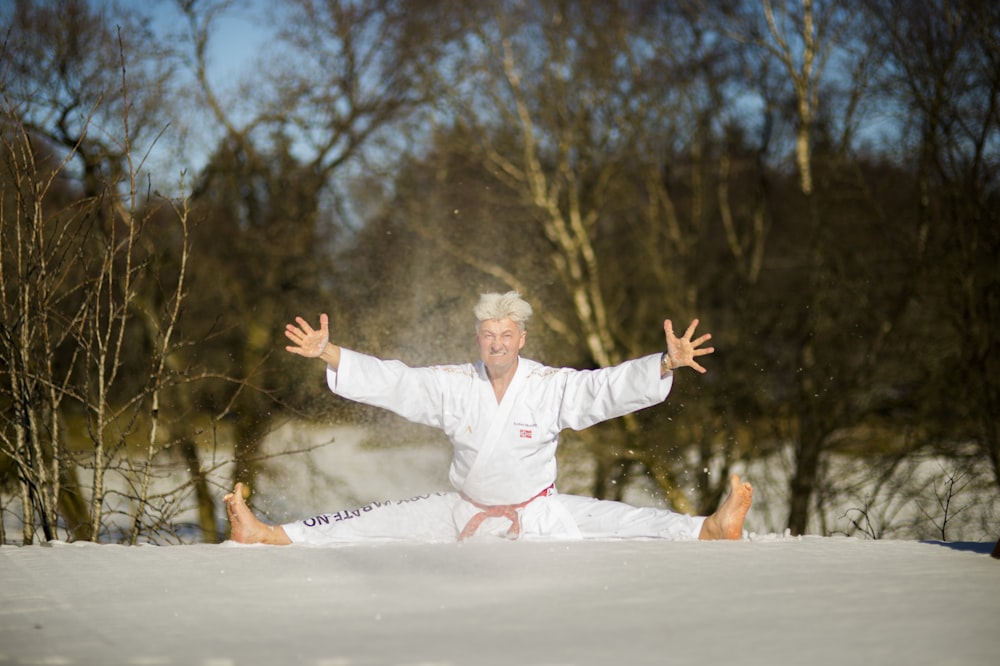
man wearing white karati gi

So, yes, I am a man. But that doesn't mean what it seems to mean. I am also yin, concealed in yang; dark veiled in light, nightfall remembered at dawn. So are all we humens (huwomens?) as everyday humans.

In Tai Chi we are urged to watch ourselves in the gym wall mirrors. Let the flowing images of your existence this very moment become apparent to your casual gaze. But never stare at yourself - the man in the mirror. In Tai Chi a stare will stall you out, freeze you in mid-flight, lead to a crash in consciousness, perhaps cause you to vanish.

Now we're back suddenly to the problem of dynamic fiction and its writer. If the creative novel, short story, or flash fiction is dynamic - that is to say, "alive" - then I or you the author have vanished and we readers are held captive in the minds and motions of the characters, striving to either thrive or survive the world they find themselves stranded in or blessed with. These character flow through their own predestined lives unaware of their looming fates and without reflective mirrors to advise them.

What if we can't find any of these reflective mirrors I'm calling for to cautions us in our own lives? No still morning lakes rimmed in mist to see ourselves in from the docks or boats? No rain-sheened roadways reflecting us up from our feet skyward? No pricy gyms walled in reflective glass to admire us? Then, half close your eyes and try to remember (but not necessarily understand) yourself in motion right now - at play in the body and mind.

Are you moving as the wind moves, the tides flow, the white crane flys?

No? Then that's not Tai Chi you're doing. Not yet...

Let go.

Vanish into the mirror even as you watch yourself go...

The self-transcending (and self-trancing) Tai Chi form that can be described in words is not the Tai Chi form we practice for energy, strength, health, and longevity.

The Tai Chi form we perform and that sweeps us away into energy, strength, health, and longevity is not the form at all, but our approach to the form and our experience of its flows.

Wrists, toes, palms, tongue, and belly lead as organs synchronize. Heart, lungs, liver, spleen, kidneys, bowels, and glans rouse themselves into attention and commit all over again to cooperation in the dance.

We move so slowly that we can finally learn deeply and well. Our bodies remember while our minds, at first wildly thrashing for control, finally surrender to the beauty of the motions evolving out of our effortless efforts.

In all of these word sequences I am merely trying to show you the internal realities of the Tai Chi dance, not tell you about the logical connectives of muscle, joint, tendon, bone, and faciea.

As a writer of fictions I surrender to a need to create a newer world into which I invite you, showing its wonders to you without wanting to tell you of them. I want you to be there with me - in the dance. As in Tai Chi when a whole class of students synchronize with the teacher, birds flying in tight formation, seamlessly synchronized, unaware of anything beyond each other.

Come, fly away with us.


https://ezinearticles.com/?The-Vanishing-Man-in-the-Mirror&id=8658539

Shifting Out of Negative Space


Meditating does not mean that you extract that part of your memory and forget all that has ever happened before. Especially life events that hasn't served you well and more than anything in this world, you would like the "pain and suffering" to be taken away. You must know, that our mind is like the revolving earth, ever evolving and spinning in its orbit in its own perfect proximity and whatever that's been planted before, it is there and always will be.

Because it is so wide and limitless, we can choose where we would like to lead our thoughts to. Our mind is the limitless space, and "negative" spaces are fundamental to building an "image and picture" of anything we wish to put together. That is how we are able to visualize dreams, scenarios, circumstances and fragments of things we have come to learn and know about. We put those pieces together inside our heads. When you learn to "un-clutter" the mind, you get to choose to be on the other side of the "negative space" that is part of your brain and living mind and you can't turn that part "off" like a switch. You can only ever attempt to make the effort for a "shift" into a different space.

When you "quiet" the mind, you see more clearly and there is a small window of opportunity to make the "shift" when that happens. Slowly, steadily, you shift yourself to a different space - a positive one. One that contains new affirmations and thoughts, new memories, experiences and places you have recreated for yourself. Planting new seeds takes time for it to grow and also takes consistent care for it to ensure that it is healthy and strong before you can bear fruits and flowers for you to enjoy and repeat the cycle.

It is a process, a journey, a learning curve for the mind to adjust and know its way around. Just like anybody you first come to know as a stranger, our minds are the same and it could be our potential best friend or worst enemy. You can make the effort to understand her strengths and weaknesses to make the "relationship" work or you can resist, resent it and feel like it is a battle and challenge every day and feel the need to fight against it all day long. It is a choice we all have and we can make it work to our advantage.

Meditation doesn't necessarily mean sitting in a chair or on a floor and just closing your eyes in a dead quiet room that could echo your breath and forcing your mind to stop the chatter. In the beginning, this would probably be counter-active to your first step of taking the leap to have control of your mind. It would probably work better if you used other tools or routines to help jump-start your mind and introduce new positive things and subjects into it before you begin to sift and sort.

Yoga is one of the methods that best serves as a physical and also a mental workout, producing best results for both body and mind. Because you literally hold your own physical body as your object of attention, all the focus and concentration put on it will ultimately produce positive results if you commit wholeheartedly and go into the postures with intent and give it your undivided attention. If you do it consciously for a full 60 - 90 minutes every day, that would definitely lead you feeling a whole lot better re-leasing all kinds of tensions and stress in your body and mind with your attention taken away from any feelings of negativity in that frame of time and put right onto your physical body directly to tone and strengthen. It is by far one of the most effective practices for easily distracted individuals.


You can of course pick up a quieter and more subtle routine and habit like a good self-development read, (if exercising is a big issue for you for whatever reason) books of a positive nature and feed your mind with more "good stuff" so that you can "fill it up" with new knowledge that are applicable in your daily activities and one that serves you well. Painting nature also serves as an extremely good way to put your attention on bright colors and natural feel-good settings and environment over a good period of an hour straight, uninterrupted with your mind stationed in a good, happy place.

It is a little obscure as people always have this idea that only professional artists can pick up that paintbrush to do something like that. But really, you don't need to be Picasso to attempt to engage in this activity. If you have a love for nature, it will not be a difficult task for you to set your eyes on it for a full hour, however your painting turn out to become is totally irrelevant and only serves as an outlet to grab hold of your attention.

The more positive activities and attitudes you choose to include into your daily life activities, the easier the road to be able to sit down and literally do nothing and naturally be able to quiet you mind comes quickly. You will no longer have to use external tools to aid you in doing so. It will just be you, your space and your mind. That is the ultimate goal eventually. Not having to meditate while you're in an awkward pose (yoga) or having to set your eyes on something beautiful to do so (nature) will be the best outlet to go about because you take yourself and your mind everywhere you go, literally.

You can't always carry your yoga mat with you 24/7 or readily have paints and brushes in your bag pack or a new book constantly at the back of your palms so if you can eventually do it with nothing in your hands or on your plate to "keep you occupied", you have successfully achieved the best method to do your meditation. To simply just sit there, close your eyes and let it all go. (Negative thoughts and feelings) To allow well-being to enter with ease and flow, making the shift to the positive space of every-thing you ever desired for and want in your life.


http://ezinearticles.com/?Shifting-Out-of-Negative-Space&id=9493744

Everybody Wants to Achieve Success in His/Her Efforts


Everybody wants to achieve success in his/her efforts. As we pass through many facets of our lives, a large number of persons find it difficult to achieve success/progress. The reasons are many: i) inability to reflect and introspect, ii) a large number of persons is entrenched in the web of bad habits (acquired in the teenage).

To change the trend, read the "Path", understand the concepts; practice little by little. Then, you can achieve amazing success in all your endeavors.

• First, in the list that you need to do is increase your level of confidence. Of course, it is natural that the level of confidence varies from person to person. You can call it an inherent property of the body and mind together that has combined to action. But definitely, you can bring upon change if you want to achieve it. Psychologists are of the view that inaction mainly rises from lower confidence levels. If one has to achieve success then one has to gain confidence through hard work, facing failure and tackling success.

• The next thing that you can give importance to in this respect is to improve your social skills. Researchers of the University of California have found out that a successful businessman gains his so-called position by better social skills and his cognitive ability. They have performed various observations which have led them to this conclusion. Thus, they are of the view that if one is socially adept and smart then he/she can earn more and be much more successful in comparison to others. You can also take to these methods and imbibe them into your nature to witness the success you had been looking for long.

• Another thing that you should be paying attention is to your authenticity. The much-sought-after leadership quality that comes from self-disclosure and self-honesty. This helps a person to make the right decisions that are based on their values. It is true that through sincere devotion, commitment one can achieve better success than through forgery, contrition, and cheating and lack of proper devotion. So, if you are trying to emulate the efforts of a successful leader then it does not mean that you are being fake but it would mean that you are taking a serious effort to make ends be successful.

• On studying several adults and kids it was found out that grit is a significant point of success. Grit gives one the energy and the determination to make ends meet in the way they want. This helps to turn thoughts to reality maybe not in a few moments but definitely in years after working hard. What one should keep in mind is that the hope and positivity that would mark to the right path.

• The next thing will take your heart down because this is something that you will surely love to do. Psychiatrists say that investing in the relationships help in a much better way to deal with success. The key to happiness is love. This love need not be the romantic or fantasized love. It can be for family, for friends, for relatives, for your cute pets and anything and everything that is in your world. Saying that I do not negate out the romance and love that you might have always thought of. Love would definitely impart to the success in your life and make you feel happy for it.

• Stanford psychologists have found out that the way to look at personality affects their capacity for success and happiness. Those people who are having their mindsets fixed believe in intelligence, character, and creativity as unchangeable qualities. Avoiding failure is another quality that proves smartness and skill of a person. Only the people those are having mindsets of growth do recognize failure as a way to success. This can happen through facing challenges, and learning from criticisms. A common saying is that "man's true potential is unknown" and it is quite justified because the outcome would be undoubtedly the success and that would not be far behind.

• The last but not the least the ability to delay the temptation of gratification. There might be several temptations that might come in the way. You would have to refrain yourself from the temptations. Studies have been performed with small kids who were given marshmallows and were promised to be given more if they could move aside the temptation of the first one. The children who were able to stand out in the test were later found to grow up to be better human beings that the others. Their skills were refined and they were intelligent in their ways.

Thus, we believe that by increasing your confidence level, improving your social skills, paying attention to your authenticity, having grit, investing in the relationships, growing mindsets, and delaying gratification one can achieve success. These are in fact the most important and easy ways that can lead one to success. If you can understand the methods and apply them fittingly to your life then you would surely lead by overwhelming success someday in the near future.


http://ezinearticles.com/?Everybody-Wants-to-Achieve-Success-in-His/Her-Efforts&id=9612663

How To Easily Create Your Emotional, Physical And Spiritual Health

As you navigate your personal and professional vicissitudes today, you may feel disconnected and unlike your Self. It may seem like your world has been suffused with an oddity that is puzzling and unwieldy. These unfamiliar feelings may be even mysterious sensations or changes which prompt you to react differently.

This unfamiliar pattern may be your body and mind telling you that you are too immersed in too many concerns and you need to step back from your perceived obligations in order to take care of your Self. Consider that you might need more rest and relaxation on a daily basis instead of relaxing only on the weekend.

Feeling disconnected in your life can be a sign that you need to reconnect with your inner Self in order to cement your dedication to the values you know are important. Or you might need to reevaluate your food plan. Is you food plan the best for your body? Furthermore the goings on in the world distracts you, blinding you from your needs.

When you schedule in time to restore your relationship with your Self and are diligent about remembering who you are and your evolution to be more of who you are; you will ensure that you hold onto your integrity, values and goals. Your frequent reflection on managing what is most important to you strengthens your will to approach worldly concerns on your own terms, rather than at a command from others' rules and values.

Make it a habit to reflect periodically each day. Ask your Self:

-Am I utilizing my time well?

-Am I including my needs?

-Am I including adequate rest and relaxation today?

-Am I getting 7 to 8 hours of sleep regularly?

-Am I eating nutrition for my Blood Type?

-Am I getting adequate exercise and spending time in nature?

-Am I spending adequate time with my significant other, family and friends?

-Am I spending time on hobbies and other pursuits of Interest?

These basic questions will prompt specific questions that get to the root of your daily emotional, physical and spiritual health and wellness needs.

When you meet your emotional, physical and spiritual health and wellness needs daily, the feelings of disconnection and feeling unlike your Self will dissipate.


http://ezinearticles.com/?How-To-Easily-Create-Your-Emotional,-Physical-And-Spiritual-Health&id=7012328

The Science of Stress


How does stress harm both the body and the mind?

For many years now, medical doctors have been warning people of the dangers of poor stress management.

Many people still believe that stress doesn't affect the body and it's "just a state of mind." What the majority of stressed individuals do not know is that the body's natural stress response is mainly a physiological event.

This means that the effects of stress have never been limited to our minds. When a person is stressed, the whole body experiences it, too. So the idea that stress is essentially harmless because it's somehow limited to our imagination is actually a dangerous belief.

Why? Because a person who experiences chronic stress for many, many years has a much higher risk of making health conditions such as high blood pressure worse. So if you want to be physically healthier, you have to understand how stress actually affects the body.

How does stress come about?

The modern stress model gives us a simple and clear explanation of how physiological stress is roused:

1st Phase: Mental and Emotional Triggers are Engaged. A person perceives an event, situation, action or idea as negative and stressful.

2nd Phase: Psychological Stress Engaged. If a person does not release their emotions and negative thinking, the present situation causes psychological stress.

3rd Phase: Physiological Stress or "Fight or Flight" Response. Unmitigated psychological stress often leads to actual, physiological stress.

When the instinctual "fight or flight" response comes into play, a person feels an immediate surge of adrenaline, which temporarily increases a person's speed, strength and stamina.

A person's breathing rate and pulse rate also increase in preparation for sudden, intense physical activity (e.g. running away from a real, physical danger).

Stress normally abates when the perceived threat or danger finally passes. Thousands of years ago, the instinctual "fight or flight" response was extremely useful for our hunter-gatherer ancestors as they had to battle wild animals, and each other, in pre-modern society.

Scientists believe that the stress adaptation came about because our ancestors were almost always exposed to threatening or dangerous situations.

What are the signs that a person is experiencing stress?

Below are some common physical symptoms that a person is experiencing stress:


  1. Inexplicable exhaustion or fatigue
  2. Acute headaches that have a tendency to disrupt work or chores at home
  3. Shallow chest breathing
  4. Increased heart rate even when the person is not performing strenuous or challenging physical activities
  5. Minor muscular pain
  6. Twitches
  7. Facial tics
  8. Hand and arm tremors
  9. A general feeling of nervousness and anxiety
  10. Insomnia
  11. Oversleeping
  12. Inexplicable perspiring of the hands and feet
  13. Turning to different substances such as caffeine, alcohol, nicotine and even recreational drugs

The list of symptoms doesn't stop there. Here is a breakdown of the mental symptoms associated with moderate to extreme stress:


  1. Short temper
  2. Feeling angry all the time
  3. Inexplicable mood swings
  4. Feeling of isolation and helplessness
  5. Short term memory problems
  6. General decrease in work productivity
  7. Lowered sexual desire
  8. Distracted thinking

The psychological signs of stress often manifest when a person has been under stress for a long period of time. These signs come about because the mind is trying to escape the stressful situation however it can.

This is one of the main reasons why stressed individuals are often less productive in the office.

Their minds are so sick of the prolonged stress response that their own thought patterns are preventing them from focusing on the things they have to do.

The same thing happens to university students who are overwhelmed with the nature and volume of work they have to complete to pass different course subjects.

How severe are stress-related symptoms in the general population?

In the United States alone, it is estimated that 90% of all physician visits are associated with symptoms related to chronic stress. It has also been estimated that on a monthly basis, 400 million people take medication to ease these symptoms.

Of course, we know now that medicating a stress-related symptom is a futile effort because you're not addressing the main cause of the symptom - you're just padding the symptom itself.

Now, it should be noted that the symptoms we discussed earlier may also be genuine signs of other health conditions (and not just stress). Consulting with your physician is still your best option if you experience symptoms such as racing heart rate or persistent headaches.

http://ezinearticles.com/?The-Science-of-Stress&id=9370368

A Key To Healing Trauma


What do world-class-athletes and special-forces combat soldiers have in common? They both perform, very well, under high stress and pressure, what might for us be a traumatic experience. How do they do that? It is the very same process used as the key ingredient in healing trauma.

To understand how some people can perform so well under acute stress and almost unbearable pressure, without becoming traumatized, and how people heal from trauma, we need to understand a little bit about how our brain works. Without getting overly technical, there are two pertinent functions of the brain involved, our executive functions, and our emotions. The executive functions, such as rational thinking and planning are referred to as higher brain functions. Our emotions, such as feelings of joy, and fear, are more basic brain functions. When we are in high stress situations, we are often frightened. The more basic brain functions, primary of which is survival, become highly activated and over-ride our higher brain functions. This is a basic neurological wiring for survival. When we are in situation of perceived danger or very high stress, we don't think, we automatically react with what is called the 'fight or flight' response. If we cannot fight, and cannot flee, we are trapped, stuck, frozen. And that then becomes the trauma. Being stuck, frozen, for an extended period of time; not being able to fight or flee, not being able to act, in a high stress, dangerous, painful, scary, situation, is a traumatic event.

When in this traumatic situation of being stuck, trapped, frozen, unable to think or plan, and at the mercy of our emotional brain centers, our higher brain functions are actually shut down, offline, not available. It is as if our emotional brain has hijacked our higher brain, kind of like a classroom of unruly kids taking over and disallowing the teacher from performing their assigned duties. But, those unruly kids are being told there is a crisis! Because our higher brain functions have to do with planning, when they are shut down, we don't have a sense of past or future. We are in the immediate present, which in a traumatic situation, is scary, frightening and may be painful. So, any time we remember this traumatic situation, even months, or years, after it has happened, our higher brain function shuts down again, goes offline, and we believe the stress and danger is real, right now. The brain does not distinguish between memory and fantasy. It is visual imagery, rapid commentary, and complex changes in breathing, skin response, neuro-chemistry and awareness. The brain does want to resolve this trauma, and so we do have intrusive thoughts, memories, flashbacks, in an attempt to help us get unfrozen, to fight, or flee, or do something. But, what happens is we just get re-traumatized because there is nothing to fight, and no-where-to-flee; We are again stuck, traumatized. What if we could maintain our higher brain functions even in high stress? Even in neutralizing the trauma?

How do we get back our higher brain functions? How can we reinstate our executive functions? How can we think, clearly, and know that the trauma is not now, is not a threat or a danger anymore? There are two points to consider along these lines. One, as mentioned in Waking The Tiger, by Peter A. Levine, a classic book in the field of sexual abuse and trauma recovery, is learning how to 'shake it off.' Animals in the wild, pursued by a predator, and escaping, are not traumatized the next day, or next month, or next year. Somehow, they shake it off. Exercise, vigorous and demanding, is a way of shaking it off. There is an interesting proximity to the word 'exercise' and 'exorcise.' We need to exorcise the build-up of stress chemicals in the body which have had no outlet, no opportunity to fight, or flee, and exercise is a good way of doing that. The other helpful approach is learning how to relax the body. In a relaxed body, the higher brain functions are much less susceptible to being hijacked by the emotions. A lot of trauma therapy is based on pairing a relaxed state of body, and mind, with exposure to traumatic memories. This can result in the executive functioning of the brain, distinguishing between past, present and future, between seeing, and feeling, the trauma as something in the past, not the present; and that goes a long way in diminishing symptoms. The trauma itself is now seen as a historical event, one which does not pose a threat to the present. This is the key in healing trauma. It's not a trauma anymore. We need to relax before we can make the distinction between then and now.

We generally don't know how to relax the body well. It is something we need to learn how to do. By taking proactive steps in learning how to relax the body before a stressful situation, we are more likely to be the executive than the unruly child in that stressful situation, which itself can be an effective prophylactic to trauma.


http://ezinearticles.com/?A-Key-To-Healing-Trauma&id=9514495

Body & Mind As One

If you stood there bare naked, would your eyes go straight to that extra belly fat you've been carrying around for a long time or would your attention and first reaction go to all the parts you love most about yourself? We've all been there and done it and stand guilty as charged. We have trained our eyes and mind to almost automatically set our attention on our "flaws" every single time we look at ourselves.

In theory, our body is made up of flesh, bones, blood and skin that has trillions of cells residing inside with its respective functioning organs working throughout our whole lives for us but in reality, our body is like a sacred temple we were supposed to take good care of religiously. (metaphorically speaking)

Instrumentally, we were "built and designed" to work the same way. To have the 5 important and crucial main gifts that allow us to enjoy life no matter where and when we want to do so. We just got to tune in and be in harmony with them.

We have eyes to see, ears to hear, nose to smell, mouth to taste and our largest organ - our skin to feel texture and sensations. Yet, we all take these for granted and choose to nit-pick on the most superficial part of us that more often than not, doesn't even serve a functioning purpose, let alone giving us pleasures of any kind. In fact, giving it attention just stirs up even more insecurities, doubts and every possible negative feelings. Some would want a higher nose bridge, smaller nostrils, bigger lips, bigger eyes, and the list goes on.

In order to connect our minds to our body, we got to learn to come to terms with what we've got and embrace its rough edges and the thing about beauty is, it really lies in the eye of the beholder. If you can't even love yourself just the way you are, how can you expect anyone else to even begin to do so? When you carry negative feelings for yourself and criticize harshly, it will reflect and bounce off right out of your skin quite literally.

Beauty does indeed lie in the eyes of the beholder and that person has to be you. Because the world sees you, through your eyes.

7 Reasons Why Life Is Better Without Booze


I was the consummate party girl for 20 years before I finally realized that alcohol was taking more than it was giving. I quit drinking two and a half years ago at the age of 35 and have never felt happier, more confident, or as in control of my own destiny than I do now that I'm sober.

Here are just a few of the reasons why life is better when it's alcohol-free: 
 
1. Your health gets better. Becoming a non-drinker reduces your chances of developing a plethora of alcohol-related illnesses, from various cancers to liver and heart disease. 

2. Your looks improve. Alcohol is responsible for puffiness in the face, sunken eyes, premature aging of the skin, and a dull complexion. Becoming a non-drinker will result in healthier looking skin and brighter eyes.

3. It's easier to maintain the weight you want. One bottle of wine has as many as 700 calories, more than a Big Mac! Plus, when you give up wine, you’re more likely to exercise if your weekends aren’t taken over by hangovers.

4. You have more time to get stuff done. If you regularly crack open a bottle of wine after dinner and have a few glasses during the course of the evening, you'll be down approximately 30 hours every week on time to GET STUFF DONE! That’s time to organize the kids for school the next day, time to blast the housework, or time to read, study or develop a hobby or skill. A boozy lifestyle equals non-productive evenings.

4b. You can even finish a book. I've always tried to write a book, but never finished more than a few chapters, when I'd inevitably hit the wine. Now, as a non-drinker, I've just had my first book published, The Sober Revolution, co-written with Sarah Turner, and am already partway through writing the next.

5. You have more patience. As someone who drank almost every night, and often to excess, I was less than patient as a parent to my eldest daughter. Now the mother of a second little girl, my parenting skills have grown massively and I always know I'm doing my best as a mum.

6. You find out who you really are. Alcohol has such a powerful effect on the body and mind that it’s impossible to find out who you are when you’re regularly getting sloshed. It's only with living alcohol-free that true self-discovery becomes a possibility. By learning to know yourself better, you have a fighting chance of finding out what you want from life, as well as all that you're capable of achieving.

7. You feel good about your life. When you're permanently sober, your choices are always your own; alcohol-free living means never waking up again crippled with regret and shame. And that is priceless.

After breaking free from the alcohol trap, I desperately wanted to help others see how much better life is without the constant negative cycle of drinking to excess, bad hangovers, and mornings filled with regrets. That’s why I set up Soberistas.com, a website which brings together a totally non-judgmental community of like-minded people who've either kicked the booze or who are looking for help in doing so. 

Good luck with your journey and keep me posted!
