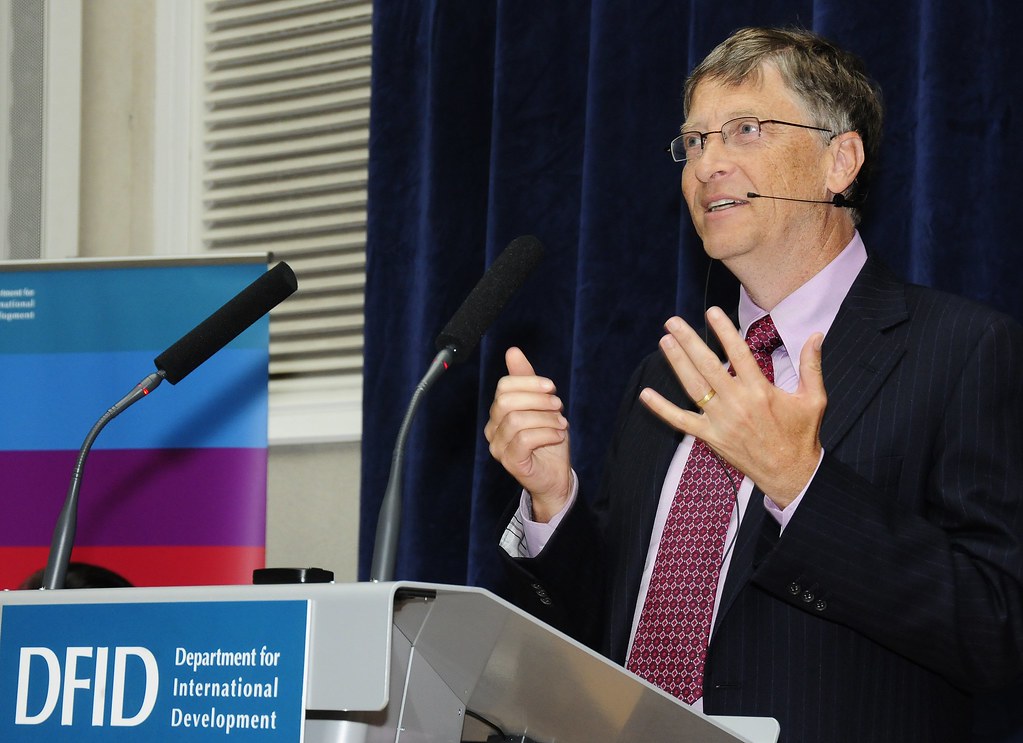
With a net worth of $80 billion, Bill Gates happens to be the richest man on the planet. More than that, though, many are drawn to Gates and his ideas due to his everyday demeanor and down-to-earth presentation style.
In coaching a number of high-level executives on presentations in the last two years, I've used the following talk (filmed at an official TED conference in 2013) to illustrate many aspects that go into a good presentation.
Here are 10 points I like to highlight:
1. Grab their attention.
Gates catches our attention with an interesting statement: Everyone needs a coach. He goes on to cite some convincing examples, and then uses humor to break the ice. This helps to build the connection between him and the audience.
The "interesting statement" is only one method I recommend to get your audience's attention.
2. Use gestures.
By using his hands, shoulders, and facial expressions, Gates animates his speech. He primarily uses emphatic gestures, which express feeling and conviction.
You can also use descriptive gestures to help express action, or to show dimension and location. If you're trying to learn how to use descriptive gestures, imagine you're speaking to someone who doesn't understand English well. Then use your hands as you're speaking, to help fill in the gaps.
3. Be enthusiastic.
Enthusiastic? Bill Gates? I admit, he's no Steve Ballmer.
But he doesn't have to be--and neither do you. Enthusiasm means that you show you're interested in the subject you're presenting, in a natural and authentic way. This comes across well in Gates's talk.
4. Ask effective questions.
When you make a statement to your audience, they're passive. Asking questions gets them involved mentally, making them active.
When he asks the question, then pauses slightly, we stay with him more easily than if he were to just tell us.
5. Pause.
Most speakers have trouble with pausing. They don't want to be up there to begin with, so they rush through as quickly as possible. But pausing effectively can help you stay in control of your presentation, can emphasize main points, and makes the talk much easier to listen to.
Gates pauses well throughout his talk.
When you learn to pause well, your presentation is easier to follow, and your main points stand out.
6. No death by PowerPoint.
It's fitting that the man whose company invented PowerPoint knows how to use it. No reading slides filled with long, drawn out text. Slides are minimal, and used primarily to emphasize key words.
When creating your slides, think: big font, limited text.
7. Sense stress.
Sense stress involves learning to emphasize the right words, so ideas are easier to understand.
For example,
"When Melinda and I learned how little useful feedback most teachers get, we were blown away."
By emphasizing the word "little," Gates shows us that teachers don't get much feedback at all. But what if he emphasized the word "useful," like this:
"When Melinda and I learned how little useful feedback most teachers get, we were blown away."
See the difference? Here he would be implying that teachers get plenty of feedback, but not much of it is useful. (Which, of course, is not the point he's trying to make.)
Learn to emphasize the right word(s), and you have a powerful tool at your disposal.
8. Cite examples.
Speaking about the topic "Measures of effective teaching," Gates mentions an arrangement for observers to watch videos of teachers, and to rate those performances on a range of practices.
Many speakers would quickly move on to the results, but Gates doesn't do that. Instead, he cites examples of the questions, to help us better understand what he's talking about:
- Did they ask their students challenging questions?
- Did they find multiple ways to explain an idea?
When you speak about an idea or process to your audience, you know exactly what you're talking about. But the audience doesn't. These concepts can be very abstract without concrete examples to illustrate.
Give us examples, and you'll keep our attention.
9. Use your conclusion to motivate.
The conclusion has the potential to influence the effectiveness of the rest of your presentation.
He tries hard to appeal to the audience's sense of higher purpose. By implementing this new form of feedback, in essence, we can help students:
- Get a better education
- Find careers that are more fulfilling and rewarding
- Live out their dreams
Come on! Who doesn't want to help kids live out their dreams? What kind of monster are you?
But that's not all. We can also become:
- A more successful country
- A more fair and just people
If you're not with Bill Gates at this point, you're pretty much anti-American and against justice.
Is that a fair assessment? No.
But it is motivating.
10. Be yourself.
The great thing about presenting is that there are so many different styles that are successful.
Gates does a great job on this presentation. But Steve Jobs, with a completely different manner, was also a great presenter. And so are a million other people. Some speak faster, some slower. Some excitable, some calm.
The key is to learn how to be yourself, even in front of a crowd.