Showing posts with label growth mindset. Show all posts

How To Have The Mindset For Success


Learning how to have the mindset for success is crucial when you want a successful and blissful life. If you are like me, you might have many goals you want to achieve. Whatever these goals are, the key is to have a growth mindset rather than a fixed one. But what is the difference and how you get it?
How can you set and have the mindset for success? Do you want to reach your goals more rapidly? In how many years did you plan to achieve your goals?

Many people, as well as I, preach hard work, focus, persistence and more but these are by-products of something else. It is something much more powerful than we can all develop. This extraordinary thing is critical to success, and it is your mindset.

Without the right mindset, you might find yourself sidetracked by your everyday routine. You can also often be distracted by the latest and most fabulous idea you are just having, which rarely pushes you to follow one path until successful.

You may think that you have all the time in the world to achieve your goals. But you have to realize that if you set your mindset for success, you can apply it to other domains as well. In this way, you will reach your goals much faster and find yourself with the capacity to possibly form new and bigger goals.

The Trap of the Mindset
It is always better to fail many times before succeeding as it will help you avoid many of the psychological traps. One of the key traps is to believe that you are smarter than other people, or that you do not have to work hard because you have talent, or that you have nothing to learn.

To have the right mindset to be successful in life, you do not need to have extraordinary intelligence or be gifted with talents.

"The moment you believe that success is determined by an ingrained level of ability, you will brittle in the face of adversity." - Josh W., International Chess champion.
So, as soon as you think success is determined by talent, you become weak when you have to face obstacles.

The Difference between a Fixed and Growth Mindset
So as soon as people see intelligence or abilities as fixed, they believe that many things are impossible for them to achieve because they put limits on themselves and their skills. And that is what is called a fixed mindset.

But other persons see abilities as qualities that can be developed which is, in this case, called a growth mindset. The important part is that those two different frames of mind lead to not the same behaviors and results.

When you have a growth mindset, you know you can change your intelligence, and increase your aptitudes and skills over time. But people with a fixed mindset do not think it is possible. So, the difference between the two groups is the perspective on intellect and brainpower.

The Possibility of a Different Mindset
Many studies have shown similar effects for the mindset about any ability such as problem-solving, playing sports, managing people or anything else you would like. The key to success is not merely effort, focus or resilience, but it is the growth mindset that creates them.

Your mindset is critical. When you directly are trying to build determination or persistence, it is not nearly as effective as if as addressing the mind frame that underlies these traits. How many people think of themselves as not creative people, or sociable, or math oriented, or even athletic?

On the other hand, some people may think that they are naturals. But if you want to fulfill your full potential, you need to start thinking differently. You have to realize that you not chained to your current capabilities and that you can modify your mindset.

A Mindset Can Be Changed


You should know that your brain is very malleable and has plasticity. You can change your ability to think and to perform. In fact, many of the accomplished people of our era were thought by experts to have no more future. People like Charles Darwin, Marcel Proust, and many others but they along with all high achievers such as Mozart to Einstein built their abilities.

But the vital thing here is to realize that you can change your ability and picture yourself where you want to be. When you have a growth mindset, you bring your game to new levels. So, how does a growth frame of mind do that?

Well, there are biological manifestations to mindset. Tests show that with people who have a fixed mindset, the brain becomes most active when they receive information about how they perform. Whereas people with a growth mindset, they have their mind being most active when they receive information about what they could do better next time.

The Choice of a Growth Mindset
In other words, people with a fixed frame of mind worry the most about how they are judged while those with a growth mindset focus the most on learning. There are other consequences about outlook. A fixed mind sees effort as a bad thing, something that only people with low capabilities need while those with a growth approach see effort as what makes them smart and as a way to grow.

And when they hit a setback or failure, people with a fixed mindset tend to conclude that they are incapable, so to protect their ego, they lose interest or withdraw. It is often taken as a lack of motivation, but behind it is a fixed frame of mind.

Whereas, people with a growth frame of mind believe that setbacks are a part of personal development. They find a way around the problem. So it means that you have to challenge yourself. But it also says that you have to praise yourself for being great at something or being smart; so do not also forget to honor others and even children for the same things.

Mindset Affects Everything
Trying hard pushes you to work even harder next time you face a challenge. Do not get into the fixed mindset of thinking that when you win, you are a winner and when you lose, it must make you a loser. The reason being is that your mindset affects your performance.

Remember that you can change your mindset any time you wish. And that is important because many people have a fixed mind frame about something or another. When you teach or have a growth mindset, not only it improves you as an all, but it also narrows down the achievement gap.

Mindset affects all of us. In the workplace, managers and supervisors with a fixed mindset do not accept feedback as much, and they do not mentor people. A wrong or right frame of mind even touches relationships, sports, and health.

Why do schools not teach the growth mindset to children rather than being so critical?

Tips to Have the Mindset for Success


  • Get a growth mindset.
  • Develop Success Habits.
  • Recognize that a growth mindset is beneficial.
  • Know that your brain changes when you work hard to improve yourself.
  • Make a small step toward each of your goals each day.
  • Learn how to develop your abilities as well as teaching others.
  • Capture all of the information that could help you.
  • Do a deliberate daily practice to develop your abilities through effective effort.
  • Listen to audio books or learn a new language on your phone while you are out for a walk rather than music.
  • Clip articles and inspiring ideas for a vision board.
  • Learn from your failures by asking yourself what you learned from the experience.
  • Know your strengths and weaknesses.
  • Develop core skills that will help you reach and achieve your goals.
  • After experiencing a setback, do not dwell on it. Instead, make an evaluation, and move on to the next thing.

And so, learn that to have a right mindset will allow you to succeed beyond all your expectations. You have to learn to talk back with a growth mindset voice when you listen and hear your fixed mind frame. Therefore, when you hear it say "You can't," just add another word to it which is "Yet."


http://ezinearticles.com/?How-To-Have-The-Mindset-For-Success&id=9807246

This Is Why Working Harder on Yourself Than Your Job Is The Key to a Great Fortune


A Powerful Inner Resolve

The late American motivational speaker Jim Rohn knew something many people don't: success is an inside job.

A good deal of your future success will arise from your mindset.

It is no surprise that those who are successful encounter frequent setbacks and failures.

To the uninitiated, failure may represent the absence of success. However, the person with a growth mindset knows failure is an opportunity to improve on their last attempt, drawing them closer to success.

If success is a journey then it comprises valleys and peaks, notwithstanding the many setbacks.

Gary Keller and Jay Papasan write in The One Thing: The Surprisingly Simple Truth Behind Extraordinary Results: "Extraordinary results aren't built solely on extraordinary results. They're built on failure too. In fact, it would be accurate to say that we fail our way to success."

The key to success lies in your willingness and determination to prevail, even in the face of adversity. It is an inner knowing, despite evidence to the contrary, that you will overcome your obstacles and silence your critics.

The right mindset and a powerful inner resolve are required on the path to success.

Setbacks are not intended to discourage you from attaining victory. They are orchestrated to enrich your personal growth and lead you closer to success if you stay the distance.

Working harder on yourself than your job requires paying attention to your mindset and nurturing your inner most thoughts.

Every failure, every obstacle draws you closer to the person you must become to realise victory.

Success is the sum of your personal growth. The person who attains outstanding success has cultivated their inner world and surmounted the challenges imposed upon them.

"Success builds on success, and as this happens, over and over, you move toward the highest success possible," write Gary Keller and Jay Papasan.

Upgrade Your Mindset

Those who work hard on themselves instead of their job are invested in their personal development. They are committed to reading books, attending seminars and lectures, working with the right coaches and mentors and are lifelong learners.

They are humble in the face of victory and gracious in defeat. They realise life is about constant learning, developing and nurturing their greatest asset - themselves.

They do not have all the answers, but are willing to step out of their comfort zone and try new things, knowing the slightest information will create a snowball effect in terms of success when the time is right.

It was the French poet Victor Hugo who once said: "Nothing is more powerful than an idea whose time has come."

The person who works hard on themselves is a leader who helps others succeed before them. They understand that in giving, they receive greater abundance and prosperity. This is a universal law and principle that whatever you sow, you shall reap.

A job pays you wages and if you are involved in sales, a commission. Nevertheless, it was Jim Rohn who reiterated in his talks: "Profits are better than wages."

He understood that when a person develops their greatest asset and their innate strengths, he or she can create unlimited income. A wage is the fee you receive set by your employer, based on the exchange of services rendered.

Profits are unlimited only by your earning potential.

Jeff Olson explains in The Slight Edge: "Every day, in every moment, you get to exercise choices that will determine whether or not you will become a great person, living a great life. Greatness is not something predetermined, predestined or carved into your fate by forces beyond your control. Greatness is always in the moment of the decision."

As you upgrade your mindset, so too does your bottom line.

Many people are unwilling to develop their greatest assets because they need certainty in their lives by way of a weekly income. It is this want for security that is their downfall because the harder you work on yourself, the greater your fortune because the sky is the limit.

You will only soar as high as you believe yourself capable of.

Therefore, your self-worth will determine your net worth.

As you develop a superior mindset, your net worth skyrockets because you are invested in your greatness, which yields far greater returns on your income.

The greatest fortunes are those developed over time, because success is a journey and requires staying the course.

Success requires a growth mindset that leads to the greatest victory and fortunes.

It is the pay-off of devoting time and energy on yourself, rather than simply working harder in your job.


http://ezinearticles.com/?This-Is-Why-Working-Harder-on-Yourself-Than-Your-Job-Is-The-Key-to-a-Great-Fortune&id=9782655

A Growth Mindset


How many people have a memory seared into their brains of one particular mistake made in school or on the job that was simply so mortifying that they never, ever, ever made that same mistake again? In other words, they learned the hard way but they really learned that lesson. For life.

I was listening to an interview last week with Reshma Saujani, founder of Girls Who Code, in which she was discussing her inspiration for starting the non-profit organization. In short, she was galvanized by the disparity she saw between the way girls and boys were taught to approach risk and potential failure throughout childhood and adolescence. She saw girls being encouraged to strive for perfection, therefore making them less likely to seek out new challenges or activities at which they might fail. She felt that coding, an endeavor that could easily be described as a never-ending series of tweaks, mini-failures, and fixes, was not only a valuable way to "re-train" this failure avoidance in young girls, but also an important step in closing the gender gap in the technology field.

This got me thinking about mistake-driven learning and the importance of having the freedom to safely fail in education. In his recent article, 7 Benefits of Mistake-driven Learning, Christopher Pappas advocates for its advantages in reinforcing critical thinking and problem-solving skills, higher-level learning capacity, and the key role that trial & error + solution reformulation plays in boosting knowledge retention and comprehension. He makes the case that creating an eLearning environment where students are safe to explore consequences to their actions, and then revise their approach based on individual outcomes, is crucial to preparing them for success in the real world.

In another write-up, the same author talks even more specifically about the benefits of applying Repair Theory, which explains the fundamental role of mistakes in procedure-based learning, to the eLearning design process. By implementing realistic simulations, branching scenarios, and real-time, personalized feedback for eLearners, it is possible to create a learning environment in which students are not only safe to fail and learn from their mistakes, but one that also provides contextual layers upon which the learner is able to apply new their knowledge.

One of my recent projects involved the development of online scenario-based case studies for students in health sciences programs. Talk about a field in which rote memorization of processes and procedures will just not cut it! For students in these programs, a thorough understanding built upon a scaffolding of contextual knowledge and interconnected concepts is critical. And so the instructional design of these online cases must create an ecosystem in which the students can immerse themselves in scenarios, use critical thinking skills to make interlinked decisions, and learn from their own mistakes in a safe online environment.

The idea that we learn most effectively from real experience and from our mistakes is applicable in education and in business because it is so deeply rooted in human behavior. No one wants to make mistakes and we all (at some point) shy away from the possibility of failure. But how much better would we be if we could let go of that limiting fear, allow ourselves to be brave enough to try new things and test uncharted waters, in order to then fail fast and become better?

Never Stop Learning.

http://ezinearticles.com/?A-Growth-Mindset&id=9456844

If You Don't Know This, You'll Never Create a Career You Love

While you may know where you think you are in your career path, you may not know this.


Image result for career

You probably already know how you feel about your career, especially since we are still in the early part of the year. Just a few weeks ago, you most likely stopped and thought about how 2016 could be a game-changer for you.
But do you know this?
How you define work.
The Oxford English Dictionary defines work as "activity involving mental or physical effort done in order to achieve a purpose or result" or "mental or physical activity as a means of earning income; employment."
But what is your definition?
Since the industrial revolution, the working world has made dramatic changes. New jobs are being created every day, most of which we could never have dreamed of just decades ago. We are finding new ways for people to tap into their innate talents and leverage their expertise for the good of the world.
Yet most of us are operating under an outdated definition of work. We think work should be hard and that it should be a sacrifice. Enjoying work is simply a "nice to have" that only the big-shots are privileged to experience.
But we must remember that the mind creates the experience. As the Buddha taught,"The mind is everything. What you think, you become." Stanford psychologist Carol Dweck's research on the power of thinking and a growth mind-set provides even more evidence that our realities -- and futures -- are greatly shaped by how our minds approach the situation. It's safe to say that if you believe that work is hard, that it isn't necessarily fun, or that it is impossible to gain fulfillment from it -- then that's exactly what you will experience.
So let's rethink this. The next best step is to come up with your own definition of work. Think through the following two questions:
  1. What is your definition of work?
  2. How similar or different is your actual day-to-day work from your definition?
Ask these questions often -- not just once. Your definition of work should change as you better align your reality with your ideals.
If you want to spend the majority of your time loving what you do and feeling a deep sense of fulfillment, you need to take charge of creating this for yourself. Whether you are an entrepreneur or moving up the corporate ladder, you have more power to manage your experience of work than you believe.
So, ask yourself, do you want to spend your time doing something someone else has defined for you? Or do you want to innovate, redefine, and create something you will love?

5 Ways to Succeed at Fulfilling Your Dream


Sad, isn't it?
I mean, you're constantly frustrated with your life. You want to pursue your dreams and live a successful life, but you just can't seem to do it.
Everyone around you seems content with their lives. They seem to have achieved their dreams. Even those who are in the midst of hardship seem to be living their dreams.
And you can't help thinking ... why not me?
And it's a good question.
After all, they're not healthier than you. They're not smarter than you. They're not more interesting than you. But for some reason, they seem to have achieved their dreams without struggle. And you start to wonder...
What's their secret?
In fact, I wondered that too. I've been there, and well ... it's depressing. So, I started doing research on what successful people do differently to fulfill their dreams. And I discovered that those who succeeded had certain characteristics in common. And knowing the truth about these traits they cultivated will change everything for you too.
Use the following five tricks to help you succeed in fulfilling your dreams:
1. Cultivate a growth mindset
People can have two mindsets -- the fixed mindset and the growth mindset.
The fixed-mindset person believes leaders are born. This type of mindset person avoids taking risks because they believe their destiny is already mapped out for them.
The growth-mindset person believes you can achieve your dreams through practice, persistence, and perseverance.
The growth mindset only comes to those who accept it. After accepting a growth mindset, your brain can stretch. And because the brain is like a rubber band, it stretches depending on how much you use it.
With that mindset, you'll develop your strengths toward your dreams because you'll understand it's not through birth that dreams are achieved but rather through pursuing your dreams with maximum effort.
2. Cultivate confidence in your dream
Trust in your ability to fulfill your dream. Get out of your comfort zone. Take risks, and follow your passion day in and day out.
Your dream is a reflection of you, and only you can fulfill it. Without taking the plunge to pursue your dream, you'll stay in the same position, always wishing you had found the courage to pursue it.
Make your dream your top priority. Create a schedule that makes it part of your daily habits. By making it a consistent daily habit, you'll prevent your fears from sabotaging your progress.
Prove to yourself that you're worth giving that dream a shot. Stick to it, not just for weeks or months but for many years to come. Work hard to make the dream a reality.
The more you believe your dream will come true, the more likely you are to achieve it. According to University of Wisconsin neuroscientist, Richard Davidson, the anticipation of achieving your goals makes you work harder toward them.
Believe in your dream, and you will achieve it.
3. Cultivate delayed gratification
Let your dream be your top priority every day. Commit never to postpone working on your dream even when you don't see results right away or when the urge to quit gets overwhelming.
Let the top performers in every field motivate you; they are consistent, and they show up and deliver while everyone else is weighed down by life and that constant battle with procrastination.
Be like those kids who waited for fifteen minutes to eat their marshmallow because they wanted an extra marshmallow. By the way, those kids who waited grew up with better social skills and were more successful according to a follow-up study.
Choose the pain of discipline, and work on your dream every day, no matter how hard things get. You may not see results immediately, but the gratification you feel when all of your efforts finally come to fruition will be worth the wait.
4. Cultivate Healthy Relationships
Human beings are created to be social. Relationships influence our mental health and provide a deep meaning and fulfillment in life. To succeed in life, make healthy relationships your top priority because you need other people to thrive to accomplish your dreams.
A study conducted by Psychiatric George Vaillant on 268 Harvard undergraduate males from the class of 1938 to 1940 concluded that success depended on how well they related to other people and not how much money they had.
So surround yourself with happy people because they'll make you happy too. Refrain from toxic people, those who continuously undermine your dreams. Their negativity will eventually make you doubt your dreams too. Find people who help you believe in yourself and your goals.
5. Cultivate Gratitude
Gratitude strengthens your will power. It keeps you focused on what's working well, which allows you to take actions confidently without letting your fears get in the way.
Gratitude is available to all people. Whether you are sick or well, young or old, as long as you had a meal today, and your heart is beating, you've got something to be grateful for.
People who always feel grateful are the most successful people in life. They view the world as a place full of opportunities, despite their circumstances.
Choose to be grateful no matter your situation. And count the opportunity to pursue your dream as a blessing.
Prove to yourself that you can do it.
You can do so by staying focused on your dream.
Slowly and steadily, keep cultivating a growth mindset, confidence in your dream, delayed gratification, healthy relationships, and being grateful.
Because there is no such thing as being born with success; it's all about grit and sticking with it.
And if you do, you'll experience firsthand the beauty of achieving your dream.
You deserve to succeed.
So start taking action today.

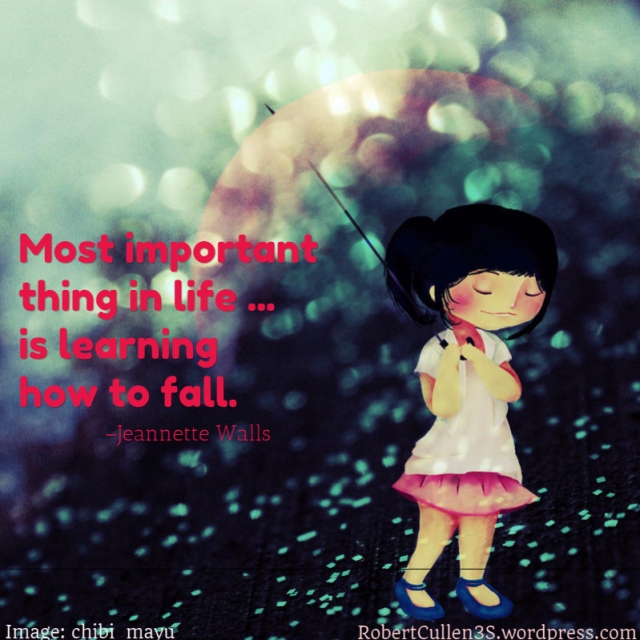
Learning how to fall is a big part of Success

Would you agree with this?
The most important thing in life… is learning how to fall.
~Jeannette Walls
3S 2015 09 Jeannette Walls quote Learning how to fall life
Most of us know that, on our road to Success, we’ve failed more often than we have succeeded. We’ve had to face a lot of pain, but we’ve put up with it for the eventual gain.
When we were learning to walk, we took so many falls that it became natural to us. Babies and toddlers think nothing of falling. But as we grow older, we begin to fear falls, both physical and metaphorical.
From the school yard to the Board Room or in the wide arena of life, failure has a stigma attached to it. But it should not be that way. Anyone who has become an expert at anything, achieved great things, done great deeds or become famous in their professional sphere knows failure is part of success. It is an essential part of success.

It is dangerous to shun failure or to never have experienced it

In fact, it is dangerous to shun failure or to never have experienced it. Children and young people who have everything going for them, and have yet to experience setbacks or failures are referred to as ‘fragile thoroughbreds’. This is because failures early in life make children more resilient. They learn to easily pick up and carry on after setbacks. But facing major setbacks after an ‘easy’ life lacking challenges can make young people fragile.
Knowing how to handle failure, and having a positive mindset about it it also important for success.
Those with a fixed mindset, who believe they have to “be good” as they are, rather than in their own potential for improvement,  are the ones who take failures most to heart. And as a result, minor setbacks make them stop trying. And that is bad. It prevents them from reaching their full potential.
Whether they are 8, 18 or 80, people with a fixed mindset are prone to limit themselves to only activities and efforts that have a high degree of success. How limiting can that be, whether in sports, arts, in a profession or vocation?

Great success comes from failures

It is no secret that great success comes from failures. Those who can learn from failures, those who believe we can improve with effort are the real winners in life. Ability to overcome fear of failure is a key component of success.
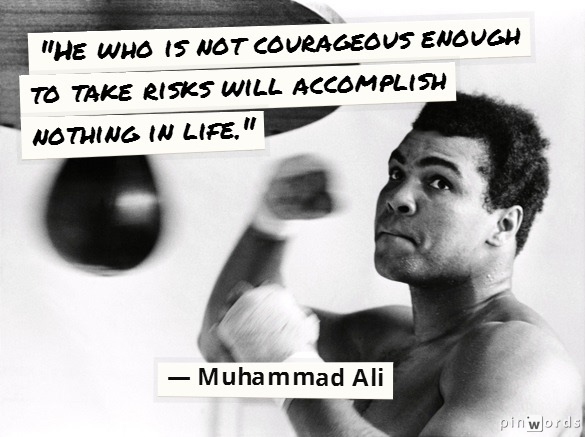
He who is not courageous enough to take risks will accomplish nothing in life.
slide_336585_3402082_free
In sports, in academics, in business, in any sphere of life or business you wish to consider, the real winners are those who have tasted bitter failure, not just once, but many times over.

A growth mindset is necessary for success

This is especially so where continuous effort is necessary to keep winning. Anyone can be a winner once in a while. But you need a good attitude towards success to be a ‘real’ winner.
Let us look at a few examples of those who have what psychologist Carol Dweck calls a growth mindset.
Not only do they believe in “becoming better”–as opposed to “being good”–they actually welcome failures and setbacks because they know there is much to learn from such experiences.

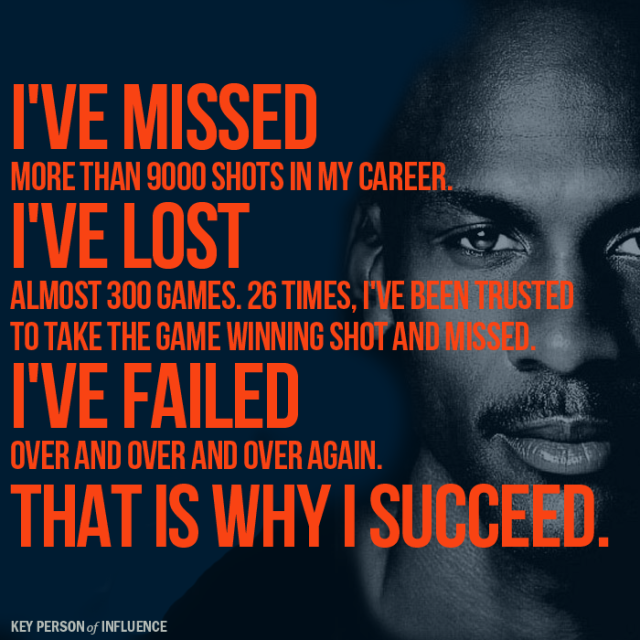
Michael Jordan

I’ve failed over and over and over again. That is why I succeed.
2014-01-michael-jordan-quotes-97

Nelson Mandela

Do not judge me by my successes, judge me by how many times I fell down and got back up again.
nelson-mandela-famous-success-quotes

J.K. Rowling

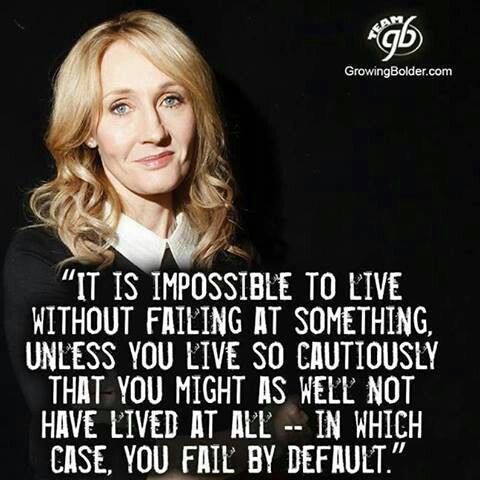
J.K. Rowling knows about failure and rejection. Twelve publishers rejected her manuscript. One year later, one publisher gave her a chance but told her to get a day job since she had little change of making money in children’s books.
It is impossible to live without failing at something, unless you live so cautiously that you might as well not have lived at all–in which case, you fail by default.
54ac9a05a04724904c99b82dc3e6f7ad

Thomas Alva Edison

And we cannot forget the classic quote on failure and success from the inventor of the light bulb about his invention  process.
I have not failed, I’ve just found 10,000 ways that won’t work.
10000-ways-that-wont-work1

Bill Gates

It’s fine to celebrate success but it is more important to heed the lessons of failure.
Clinton Global Initiative Annual Meeting In New York

The lesson is clear: Try to learn from failures

We, in America, are obsessed with success stories. But in the words of Dr. A.P.J. Abdul Kalam:
Don’t read success stories, you will only get a message.
Read failure stories, you will get some ideas to get success.
dont-read-success-stories-abdul-kalam-daily-quotes-sayings-pictures
In other words…
Most great people have attained their greatest success just one step beyond their greatest failure.~Napoleon Hill
34944__8640231159_b17759a12b_z
Find ways to overcome failure and the fear of failure.
If fear paralyzes you, you will not try anything.

3 Qualities More Important Than IQ for Success

When it comes to what determines success, many would put their money a high intelligence quotient. There’s no doubt IQ plays a role in academic achievement, but acceptance into an Ivy League school far from guarantees professional success.
CEOs who’ve recruited the brightest graduates become puzzled at the bell curve of performance—after all, shouldn’t all geniuses perform at an elite level?
Not surprisingly, researchers have found that IQ plays a far less significant role in success. It’s these three qualities, under the radar and often overlooked, that make all the difference when it comes to success. 

1. Self regulation.

We’re often the biggest stumbling blocks to our own success. The ability to manage your behaviors consistently reflects your values and goals. The famous Stanford “Marshmallow” study placed treats in front of children and told them they could eat it now, or wait and be rewarded with a double amount. After tracing the lives of the children into adulthood, they found those who resisted performed better academically, earned higher salaries and were less prone to obesity. 
Self-regulation is like a muscle. It can be depleted, but it can also be exercised and strengthened. Practice saying "no'' to yourself by refusing the desire to get on social media, eating all the food on your plate but not seconds or waking up ten minutes earlier in the morning. 
Make daily practices of doing something difficult, and just like the children with the marshmallows, habits in one area of life are contagious.

2. Empathy.

Empathy is the ability to put yourself on exactly the same page with your customer or whoever you’re engaging with.
When different views cause conflict, empathy allows for integration and reducing tension. It’s the difference between “I think you're wrong” and “I understand where you’re coming from.” The former is likely to put the person on the defensive, while  the latter invites a more constructive and open-ended engagement that creates rapport, the magic ingredient in sales.  
No one lacks the potential for greater empathy. The discovery of “mirror neurons” showed the biological ability we all possess to empathize. Watch someone face-plant and you’ll recoil and "feel" their pain.
Emotional awareness is key. Begin to observe your feelings, label them as they arise, describe your experience as if you’re interviewing yourself. As you master and become more familiar with your inner-self, you’ll start to better perceive and intuit what someone else is going through.
Most importantly, empathy shows that you care. Keep the words of Teddy Roosevelt in mind, “People don’t care how much you know until they know how much you care.”

3. Grit.

Psychologist Angela Duckworth studied successful individuals at West Point Military Academy, the National Spelling Bee, rookie teachers in tough neighborhoods and salespeople in private companies. She noted the common factor wasn't social intelligence, good looks, physical health and or I.Q. It was grit.
While self-regulation deals with temptations, grit is resilience when faced with adversity either physically and psychologically. It’s a trait synonymous with the “Growth Mindset.”
When wrestling with a problem, a fixed mindset says we’re failing and not cut-out for the job. A growth mindset believes we’re getting closer to the solution and gaining mastery. Professor Carol Dweck’s research shows that the brain develops new neural pathways if it preservers through a problem rather than throwing in the towel. 
The culprit is a psychological highjacking conditioned by the popular notion that talent is inherent and immutable, rather than malleable. Adopting a growth mindset is more than positive thinking. The cognitive shift reduces the body’s stress response. A less stressed person will process adversity more efficiently, and be able to iterate instead of hitting a brick wall. 
Cultivating grit takes patience and consistency. But it can be developed from simple daily exercises such as learning to juggle, or taking a cold shower. It’s all about applying the compound effect in finance to all areas of life.

Why attitude is more important than IQ

LinkedIn Influencer Dr. Travis Bradberry published this post originally on LinkedIn.
When it comes to success, it's easy to think that people blessed with brains are inevitably going to leave the rest of us in the dust. But new research from Stanford University will change your mind (and your attitude).
Psychologist Carol Dweck has spent her entire career studying attitude and performance, and her latest study shows that your attitude is a better predictor of your success than your IQ.
Dweck found that people's core attitudes fall into one of two categories: a fixed mindset or a growth mindset.
With a fixed mindset, you believe you are who you are and you cannot change. This creates problems when you're challenged because anything that appears to be more than you can handle is bound to make you feel hopeless and overwhelmed.
People with a growth mindset believe that they can improve with effort. They outperform those with a fixed mindset, even when they have a lower IQ, because they embrace challenges, treating them as opportunities to learn something new.
Common sense would suggest that having ability, like being smart, inspires confidence. It does, but only while the going is easy. The deciding factor in life is how you handle setbacks and challenges. People with a growth mindset welcome setbacks with open arms.
According to Dweck, success in life is all about how you deal with failure. She describes the approach to failure of people with the growth mindset this way,
"Failure is information—we label it failure, but it's more like, ‘This didn't work, and I'm a problem solver, so I'll try something else.'"
Regardless of which side of the chart you fall on, you can make changes and develop a growth mindset. What follows are some strategies that will fine-tune your mindset and help you make certain it's as growth oriented as possible.

Don't stay helpless.

We all hit moments when we feel helpless. The test is how we react to that feeling.
We can either learn from it and move forward or let it drag us down.
There are countless successful people who would have never made it if they had succumbed to feelings of helplessness: Walt Disney was fired from the Kansas City Star because he "lacked imagination and had no good ideas," Oprah Winfrey was fired from her job as a TV anchor in Baltimore for being "too emotionally invested in her stories," Henry Ford had two failed car companies prior to succeeding with Ford, and Steven Spielberg was rejected by USC's Cinematic Arts School multiple times.
Imagine what would have happened if any of these people had a fixed mindset. They would have succumbed to the rejection and given up hope.
People with a growth mindset don't feel helpless because they know that in order to be successful, you need to be willing to fail hard and then bounce right back.

Be passionate.

Empowered people pursue their passions relentlessly. There's always going to be someone who's more naturally talented than you are, but what you lack in talent, you can make up for in passion.
warren buffett
Alex Wong/GettyWarren Buffet uses the 5/25 technique to find his passions.
Empowered people's passion is what drives their unrelenting pursuit of excellence. Warren Buffet recommends finding your truest passions using, what he calls, the 5/25 technique: Write down the 25 things that you care about the most. Then, cross out the bottom 20. The remaining 5 are your true passions. Everything else is merely a distraction.

Take action.

It's not that people with a growth mindset are able to overcome their fears because they are braver than the rest of us; it's just that they know fear and anxiety are paralyzing emotions and that the best way to overcome this paralysis is to take action.
People with a growth mindset are empowered, and empowered people know that there's no such thing as a truly perfect moment to move forward. So why wait for one? Taking action turns all your worry and concern about failure into positive, focused energy.

Then go the extra mile (or two).

Empowered people give it their all, even on their worst days. They're always pushing themselves to go the extra mile.
One of Bruce Lee's pupils ran three miles every day with him. One day, they were about to hit the three-mile mark when Bruce said, "Let's do two more." His pupil was tired and said, "I'll die if I run two more." Bruce's response? "Then do it."
His pupil became so angry that he finished the full five miles. Exhausted and furious, he confronted Bruce about his comment, and Bruce explained it this way: "Quit and you might as well be dead. If you always put limits on what you can do, physical or anything else, it'll spread over into the rest of your life. It'll spread into your work, into your morality, into your entire being. There are no limits. There are plateaus, but you must not stay there; you must go beyond them. If it kills you, it kills you. A man must constantly exceed his level."
bruce lee
Archive Photos/Getty"Quit and you might as well be dead."
If you aren't getting a little bit better each day, then you're most likely getting a little worse—and what kind of life is that?

Expect results.

People with a growth mindset know that they're going to fail from time to time, but they never let that keep them from expecting results. Expecting results keeps you motivated and feeds the cycle of empowerment. After all, if you don't think you're going to succeed, then why bother?

Be flexible.

Everyone encounters unanticipated adversity. People with an empowered, growth-oriented mindset embrace adversity as a means for improvement, as opposed to something that holds them back. When an unexpected situation challenges an empowered person, they flex until they get results.

Don't complain when things don't go your way.

Complaining is an obvious sign of a fixed mindset. A growth mindset looks for opportunity in everything, so there's no room for complaints.

Bringing It All Together

By keeping track of how you respond to the little things, you can work every day to keep yourself on the right side of the chart above.