Showing posts with label presentation. Show all posts

The "Big Four" in Reading Body Language


In learning to read body language, it helps to know the Big Four, that is, four major categories of movements. Each one gives you some information about a person's emotion and intent.

The Big Four in body language are:

1. Illustrators 
2. Regulators 
3. Barriers 
4. Adaptors

Illustrators punctuate what you're saying so they could be intentional or unintentional. You may automatically use your arms, torso, head, legs, and everything else to accent what you're saying. Sure, sometimes you might rehearse your movements if you're giving a presentation at a meeting, but in normal conversation, you don't deliberately choose every move you make. Everyone has a baseline style of using illustrators. When you deviate from that, it's a signal that there's a shift in the intensity of your emotions.

Regulators are movements and sounds to control another person's speech. Again, they could be intentional or unintentional. The postures and movements associated with active listening encourage the other person to keep talking. In contrast, when you clamp your lips while someone is talking, you are sending the signal that you don't want to hear any more or you don't want to hear more of the same. When you turn away slightly, it's the same kind of signal.

Barriers can help you establish personal space. They can be a body part, like an arm or a shoulder-the proverbial "cold shoulder"-or an object like a cell phone or table. They can make you look weak and afraid-like you have to hide behind something in order to have a conversation. On the flip side, when you sit behind your big desk and the person you're talking with is sitting on the other side of it, that barrier conveys the sense that you have a lot of personal real estate.

Adaptors are nervous movements that are self-soothing in nature. They might be grooming gestures, like brushing a piece of lint off your jacket even though there may be no lint there, or straightening a tie, or playing with your earrings or hair. They could be rubbing two fingers together. The use of adaptors is one of the clues of possible deception. Most people are not skilled at any level of deception, whether it's omitting a fact, distorting a fact, or embellishing a fact. Engaging in deception, even if it's minor, will probably cause some stress and that stress will leak out in the form of an adaptor.

http://ezinearticles.com/?The-Big-Four-in-Reading-Body-Language&id=9405113

Don't Be Shy - Boost Your Confidence Before Giving Your Presentation

Have you ever been in a situation where you've given a speech, a presentation or a meeting update and it hasn't flowed as well as you would have liked? You're hesitant the next time you're about to present? If you're feeling uncertain about an up and coming event (such as a meeting, speech or presentation) check out these 10 pre-event confidence-boosting questions and see if answering them makes the difference:

1. Are you certain of your core message, point or outcome? If not establish what this is from the outset and allow everything else to flow from it

2. Have you prepared well enough for the event? If not what else can you do to prepare?

3. Does what you're doing make sense to you? Does it sit well with your values and principles? Just how important is it to you? How can you raise its importance in your mind?

4. What is your relationship with the people around you? Are there any issues here? How will this impact on your delivery? How can you modify your thoughts, feelings and behaviour to address the issues?

5. How can you ensure you express yourself clearly and well? (If you're certain of your core message and you're well prepared it should be much easier to state your case clearly and with conviction). Can you draw on a similar situation when things went well? What is the difference between how you felt then and how you feel now? Why is this?

6. What kind of material do you have? Is it clear and simple to understand for the visual, audio and kinaesthetic among your audience? Can you improve, simplify or clarify it?

7. Have you anticipated any tricky questions that may come up, and prepared responses to them?

8. What are you saying and thinking to yourself about the event? If you're telling yourself how badly it's going to go that's exactly what you risk manifesting

9. Have you looked at the situation from the vantage point of each person who will be at that event? What questions or issues arise when you do this? Can you deal with any of them in advance? If so how?

10. What other messages are being communicated to you from this uncertainty? What do you need to do to quell them?

Answering these questions should go some way to increasing your confidence and ensuring you are well prepared for your event.

http://ezinearticles.com/?Dont-Be-Shy---Boost-Your-Confidence-Before-Giving-Your-Presentation&id=9323267

This 10 Minute TED Talk by Bill Gates Will Teach You Everything You Need to Know About Presenting

How do you give a great presentation? Here are 10 tips from Bill Gates in action.


With a net worth of $80 billion, Bill Gates happens to be the richest man on the planet. More than that, though, many are drawn to Gates and his ideas due to his everyday demeanor and down-to-earth presentation style.
In coaching a number of high-level executives on presentations in the last two years, I've used the following talk (filmed at an official TED conference in 2013) to illustrate many aspects that go into a good presentation. 

Here are 10 points I like to highlight:

1. Grab their attention.

Gates catches our attention with an interesting statement: Everyone needs a coach. He goes on to cite some convincing examples, and then uses humor to break the ice. This helps to build the connection between him and the audience.
The "interesting statement" is only one method I recommend to get your audience's attention. 

2. Use gestures.

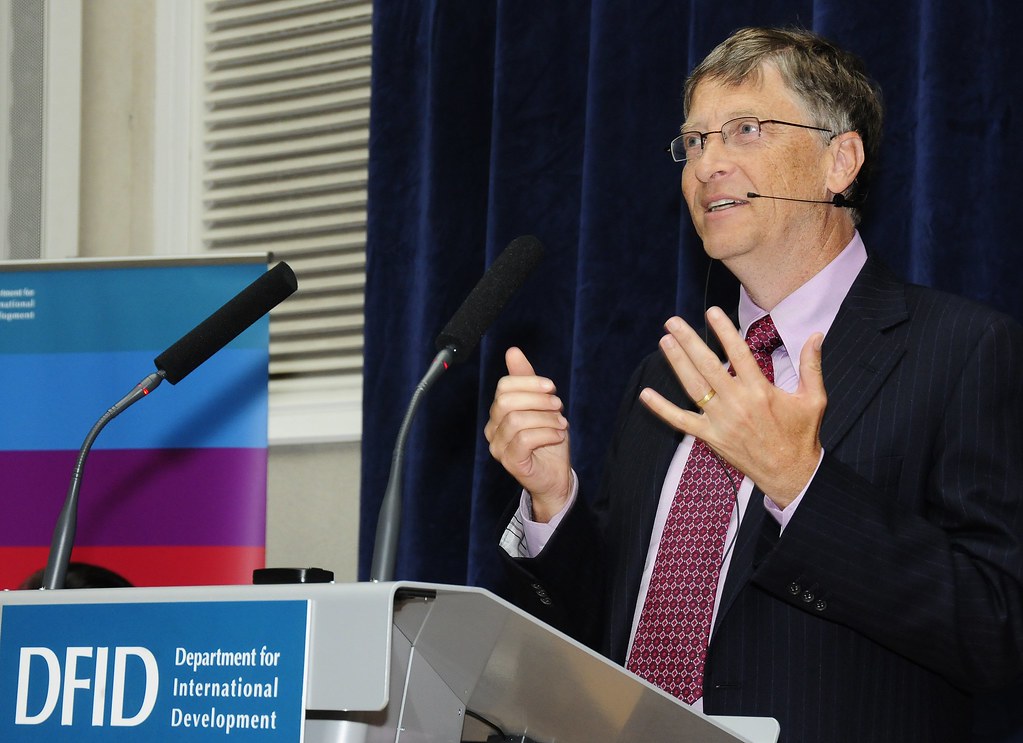
By using his hands, shoulders, and facial expressions, Gates animates his speech. He primarily uses emphatic gestures, which express feeling and conviction. 
You can also use descriptive gestures to help express action, or to show dimension and location. If you're trying to learn how to use descriptive gestures, imagine you're speaking to someone who doesn't understand English well. Then use your hands as you're speaking, to help fill in the gaps.

3. Be enthusiastic.

Enthusiastic? Bill Gates? I admit, he's no Steve Ballmer.
But he doesn't have to be--and neither do you. Enthusiasm means that you show you're interested in the subject you're presenting, in a natural and authentic way. This comes across well in Gates's talk.

4. Ask effective questions.

When you make a statement to your audience, they're passive. Asking questions gets them involved mentally, making them active.
When he asks the question, then pauses slightly, we stay with him more easily than if he were to just tell us.

5. Pause.

Most speakers have trouble with pausing. They don't want to be up there to begin with, so they rush through as quickly as possible. But pausing effectively can help you stay in control of your presentation, can emphasize main points, and makes the talk much easier to listen to.
Gates pauses well throughout his talk. 
When you learn to pause well, your presentation is easier to follow, and your main points stand out.

6. No death by PowerPoint.

It's fitting that the man whose company invented PowerPoint knows how to use it. No reading slides filled with long, drawn out text. Slides are minimal, and used primarily to emphasize key words.
When creating your slides, think: big font, limited text.

7. Sense stress.

Sense stress involves learning to emphasize the right words, so ideas are easier to understand.
For example,
"When Melinda and I learned how little useful feedback most teachers get, we were blown away."
By emphasizing the word "little," Gates shows us that teachers don't get much feedback at all. But what if he emphasized the word "useful," like this:
"When Melinda and I learned how little useful feedback most teachers get, we were blown away."
See the difference? Here he would be implying that teachers get plenty of feedback, but not much of it is useful. (Which, of course, is not the point he's trying to make.)
Learn to emphasize the right word(s), and you have a powerful tool at your disposal.

8. Cite examples.

Speaking about the topic "Measures of effective teaching," Gates mentions an arrangement for observers to watch videos of teachers, and to rate those performances on a range of practices.
Many speakers would quickly move on to the results, but Gates doesn't do that. Instead, he cites examples of the questions, to help us better understand what he's talking about:
  • Did they ask their students challenging questions?
  • Did they find multiple ways to explain an idea?
When you speak about an idea or process to your audience, you know exactly what you're talking about. But the audience doesn't. These concepts can be very abstract without concrete examples to illustrate.
Give us examples, and you'll keep our attention.

9. Use your conclusion to motivate.

The conclusion has the potential to influence the effectiveness of the rest of your presentation. 
He tries hard to appeal to the audience's sense of higher purpose. By implementing this new form of feedback, in essence, we can help students:
  • Get a better education
  • Find careers that are more fulfilling and rewarding
  • Live out their dreams
Come on! Who doesn't want to help kids live out their dreams? What kind of monster are you?
But that's not all. We can also become:
  • A more successful country
  • A more fair and just people
If you're not with Bill Gates at this point, you're pretty much anti-American and against justice.
Is that a fair assessment? No.
But it is motivating.

10. Be yourself.

The great thing about presenting is that there are so many different styles that are successful.
Gates does a great job on this presentation. But Steve Jobs, with a completely different manner, was also a great presenter. And so are a million other people. Some speak faster, some slower. Some excitable, some calm.
The key is to learn how to be yourself, even in front of a crowd.

4 Subtle Gestures That Really Turn People Off

Small movements that you make--movements you probably aren't aware of--could be the key to whether others trust you--or not.


When you deliver a presentation, your body language is important because it creates an instant visual first impression that answers a big question for your audience: "Can I trust this person?"
Until now, science had not been able to isolate the specific physical cues that could lead to distrust. But thanks to Dr. David DeSteno, a professor of psychology at North eastern University, we now know what gestures can undermine the perception of our trustworthiness.
Dr. DeSteno devised a study in which participants played an economic game that could be played cooperatively, or selfishly, in a distrustful manner. Half played face-to-face, and half played over the Internet. Those who played face-to-face were videotaped from three camera angles.
In the game, the average level of cooperation between the two groups was the same, whether the communication was in-person or over the Internet. But accuracy predicting the perceived trustworthiness of a partner was significantly greater when the communication was face-to-face. Somehow, the people playing face-to-face were better at picking up cues.
Based on the videos, the investigators built models that tied four specific gestures to perceived trustworthiness. These gestures were:
  1. Hand-touching,
  2. Touching your own face,
  3. Crossing your arms, and
  4. Leaning away.
The more a participant expressed these actions, the less he was trusted.
However, how could Dr. DeSteno be sure that other, unnoticed gestures were not contributing to the impression of untrustworthiness? People send many cues simultaneously. So he enlisted the help of a robot called Nexi, designed by Cynthia Brazil at the MIT Media Lab. For one group, Nexi was programmed to display only those gestures associated with lack of trust, while for the other group she displayed more neutral gestures.
Sure enough, those who saw Nexi display the four gestures rated her as less trustworthy than those who saw her speaking with other, more neutral gestures.
So let's take a quick look at the four gestures that could undermine the perception of trustworthiness.

Hand-touching

Hand-touching can make you look tentative and nervous, which could cause observers to think you are hiding something or not being honest, or that you lack confidence. Clasping your hands together may also be interpreted as a closing-off gesture: It could look as if you were putting up a fence between yourself and the people you're speaking with. When you see Nexi do the gesture, it looks like she's a plotting poker player gathering in a massive pile of other people's chips.

Touching your own face

Touching your own face is a common gesture that signals you are thinking. After all, you're touching your head. But what you are thinking is unknown to those who are trying to determine if you can be trusted. And if they don't know you well, the safe choice might be to decide that you're up to no good. To touch another's face is a gesture of intimacy and affection, but to touch your own face is to mask your expression.

Crossing your arms

Crossing your arms is a classic closing gesture. By doing it, you cover your heart and protect your solar plexus, the most vulnerable real estate on the body. Crossing the arms tends to communicate that your true feelings will remain undisclosed, and that you are not open for collaboration.

Leaning away


Successful public figures are trained to avoid these gestures, which is behavioral marketing: it's hard to get elected and govern if you send negative signals.We like people who like us. When you lean in, you express the desire to be close. When you lean away, you could very well be seen as someone who is running away, disengaged, or avoiding contact--you're aloof on the balcony, not moshing on the dance floor.
Those of us in business also need to earn the trust of the people we seek to influence--which is almost everyone we meet, from direct reports, to peers, to the big boss at the top of the food chain. With a little practice, you can avoid touching your hands and face, crossing your arms, or leaning away from people you're conversing with.
If you watch the video of Nexi, it's clear that Dr. DeSteno is right: Our minds ascribe moral intention to gestures--even those performed by robots--if they show any hint of emotional expression.

10 Body Language Tips Every Speaker Must Know


We all know that when we give a presentation or speak in front of a group, not only are our words important, but the body language that accompanies them.
Your words may give the audience one message while your body sends quite another.
As if getting the words out wasn't hard enough, right?
An infographic from SOAP Presentations lists 10 body language tips to employ during your next presentation. These tips range from how to get the audience to like you, to how to make sure the audience remembers your key points.
For example:
1. To get the audience to like you, make eye contact. People tend to pay more attention to and like those who look them in the eye.
2. To boost your confidence, open your chest and arms, and keep your back straight.
3. To demonstrate authority, be calm and use small, stiff gestures.
4. To draw the audience's attention to something, point directly at it and look at it yourself. The audience will follow your lead.
5. To convince the audience of something, use positive gestures — smiling, nodding, open movements, etc. — throughout the presentation.